‘Kaboom! Where Did All The Animals Go?’ – WAR AND WILDLIFE

Kaboom where did all the animals go - Copy

The catastrophe of war affects not only humans but wildlife also. During war, landscapes are destroyed.  Within every square foot of a landscape there is some form of life.  Every shell that exploded in the fields of Flanders in WWI, every mortar detonated in the forests of the Ardennes during the Battle of the Bulge, had a direct impact on the eco-system within each area.  The insects, the small mammal populations, the birds, the large mammal populations – the blind fear inflicted upon them is yet another tragedy of war.

Where do the animals go?  Many of them are killed as their habitats are destroyed.  Others evacuate the area.  It is a subject that is rarely discussed as the impingement of war on humans takes precedence.

'Lying Stag' by Nymphenburg, Germany, Artist's own collection

‘Lying Stag’ by Nymphenburg, Germany, Artist’s own collection

I wanted to make a memorial to all the animals that have been affected and will continue to be affected during each outbreak of war.  Creating a halcyon forest scene of peace and tranquility, my drawing features an exquisite bisque ‘Lying Stag’ by Nymphenburg, Germany, designed by August Göhring in 1939.  Deer are the epitome of elegance and exude an aura of serenity – but their fine, slender features betray the fragility not only of their own bodies that can so easily be broken but echo the delicacy of the ecosystems they inhabit.  The fragility of porcelain symbolises the fracturable nature of ecosystems, so easily shattered.

The Emerald City, 'The Wizard of Oz', Metro-Goldwyn-Mayer

The Emerald City, ‘The Wizard of Oz’, Metro-Goldwyn-Mayer, 1939

I decided to draw the porcelain stag as if it were made of ethereal Uranium glass, not only representing the green of forests but also the colour of the Emerald City in the film ‘The Wizard of Oz’, 1939, thus creating a halo of wonderment as we encounter the stag lying amongst the beauty of a pristine forest.   The Emerald City seems a place of beauty and promise like the forest in the drawing, but it is an illusion masking the true reality of life behind the green walls, as war creeps ever closer to the hooves of the restful stag.  A carved section of my Grandmother’s dressing table, circa 1940 reflects the harmonious relationship man is capable of having with forests, managing them properly so that sustainable wood is used for the making of furniture and carving of objects.

Artist's still photograph of a deer from 'A Prophet', Jacques Audiard, 2009

Artist’s still photograph of a deer from ‘A Prophet’, Jacques Audiard, 2009

But a drawing of a still from the film ‘A Prophet’, 2009, Jacques Audiard of a herd of deer running down a road, caught in the headlights of a car before the film continues to show one of the deer brutally run over, represents the onslaught of war.

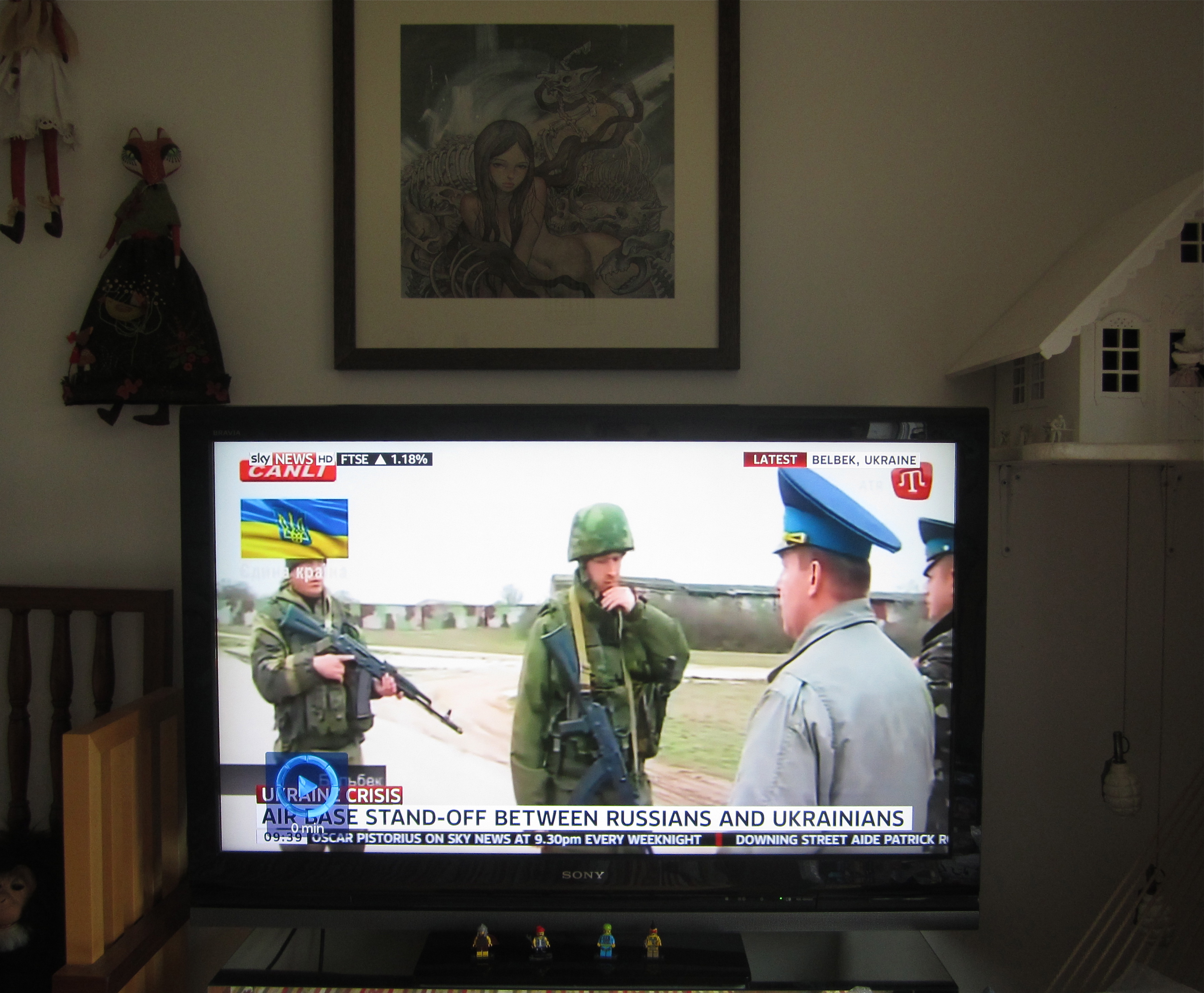
Still photograph of this morning's Sky News bulletin as the crisis deepens in Ukraine.  Ukrainain soldiers attempt to negotiate command of their headquarters with Russian soldiers who fired into the air upon their unarmed, flag carrying approach.

Still photograph of this morning’s Sky News bulletin as the crisis deepens in Ukraine. Ukrainain soldiers attempt to negotiate command of their headquarters with Russian soldiers who fired into the air upon their unarmed, flag carrying approach.

With crisis looming in Ukraine, war is never far from any of us.  It is in our nature to feud with one another.  One twitchy pull of the trigger on a gun can release the bullet that sparks the conflagration of war.  The consequences affect every living organism that encounters the fallout from that one bullet.

As I wrote the words above I happened to look up at the television and saw the images caught in my photograph of the Sky News bulletin about the Ukraine crisis and watched as a Russian soldier fired into the air at unarmed Ukrainian soldiers as they approached to try and negotiate with the Russians.  It seemed a strange and poignant co-incidence.

Kaboom where did all the animals go - Copy

Luxury Archival Pigment Prints of ‘Save Us!’ made by the excellent Jack Lowe studio are available to order from my website

“Save Us!” – The Wolves Propaganda Poster

'"Save Us!', Propaganda poster for the Wolf's House, photo montage by Jane Lee McCracken

‘”Save Us!”, Propaganda Poster’ for the Wolf’s House, photo montage by Jane Lee McCracken

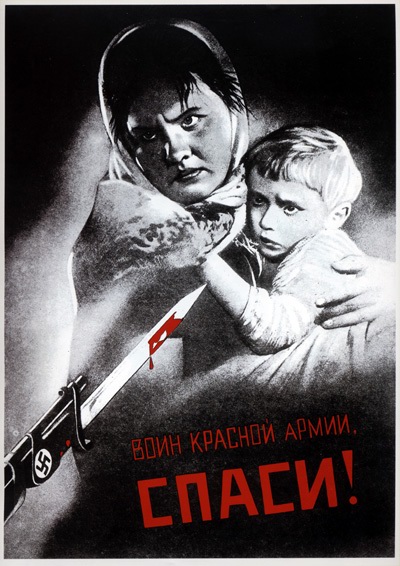
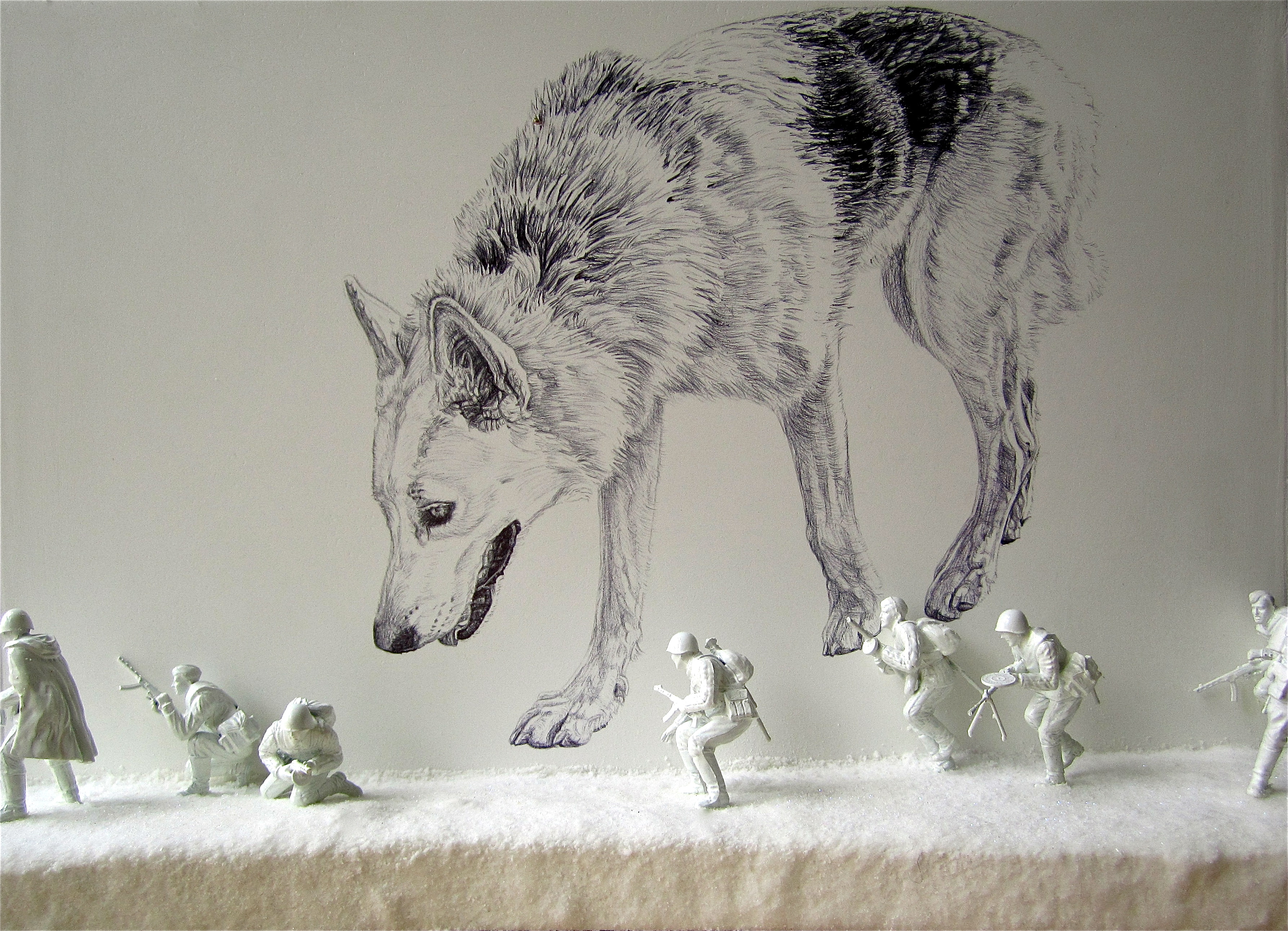
Originally conceived as the design for a miniature poster to adorn the interior walls of ‘The Wolf’s House’,  ‘”Save Us!” Propaganda Poster’ is a photo montage using prints of my original black Biro drawings of Lily, as a puppy and as a mature dog.  Her lupine features as well as her trusting expression seemed to lend perfectly to the theme of the poster.

The foundation for this piece is the famous Soviet World War II propaganda poster by Viktor Koretsky, “Red Army Soldiers, Save Us!”, 1942.  Although the Russian cyrillic translation for “Red Army Soldiers” has been removed from the design, I have left a trace of where it was originally placed, indicating the war I envisaged the inhabitants of The Wolf’s House to be planning or already waging against humans.  Retaining the Russian translation for “Save Us!” from Koretsky’s original poster in my design, incites a message that is woven throughout the symbolism of The Wolf’s House, promoting conservation of threatened species.

"Red Army Soldiers, Save Us!", original 1942 Soviet WWII propaganda poster by

“Red Army Soldiers, Save Us!”, original 1942 Soviet WWII propaganda poster by

The Kafka-esque images I imagined of wolves holding secret meetings in ‘The Wolf’s House’, planning their epic battle against humans were perhaps triggered not only by my drawing of 2010,  “TV Screen III – ‘East Meets West, Forests’ Memories'” but also by my husband’s description of  the music video for ‘There, There’, 2003, whilst we were listening to Radiohead’s ‘Hail to the Thief’ during a car journey to Scotland.  His description was powerful as I didn’t get round to watching the video until last year, a year after the creation of The Wolf’s House.

'"Save Us!', Propaganda poster for the Wolf's House, photo montage by Jane Lee McCracken

‘”Save Us!’, Propaganda Poster’, Archival Pigment Print

Luxury Archival Pigment Prints of ‘Save Us!’ made by the excellent Jack Lowe studio are available to order from my website

The Wolf’s House

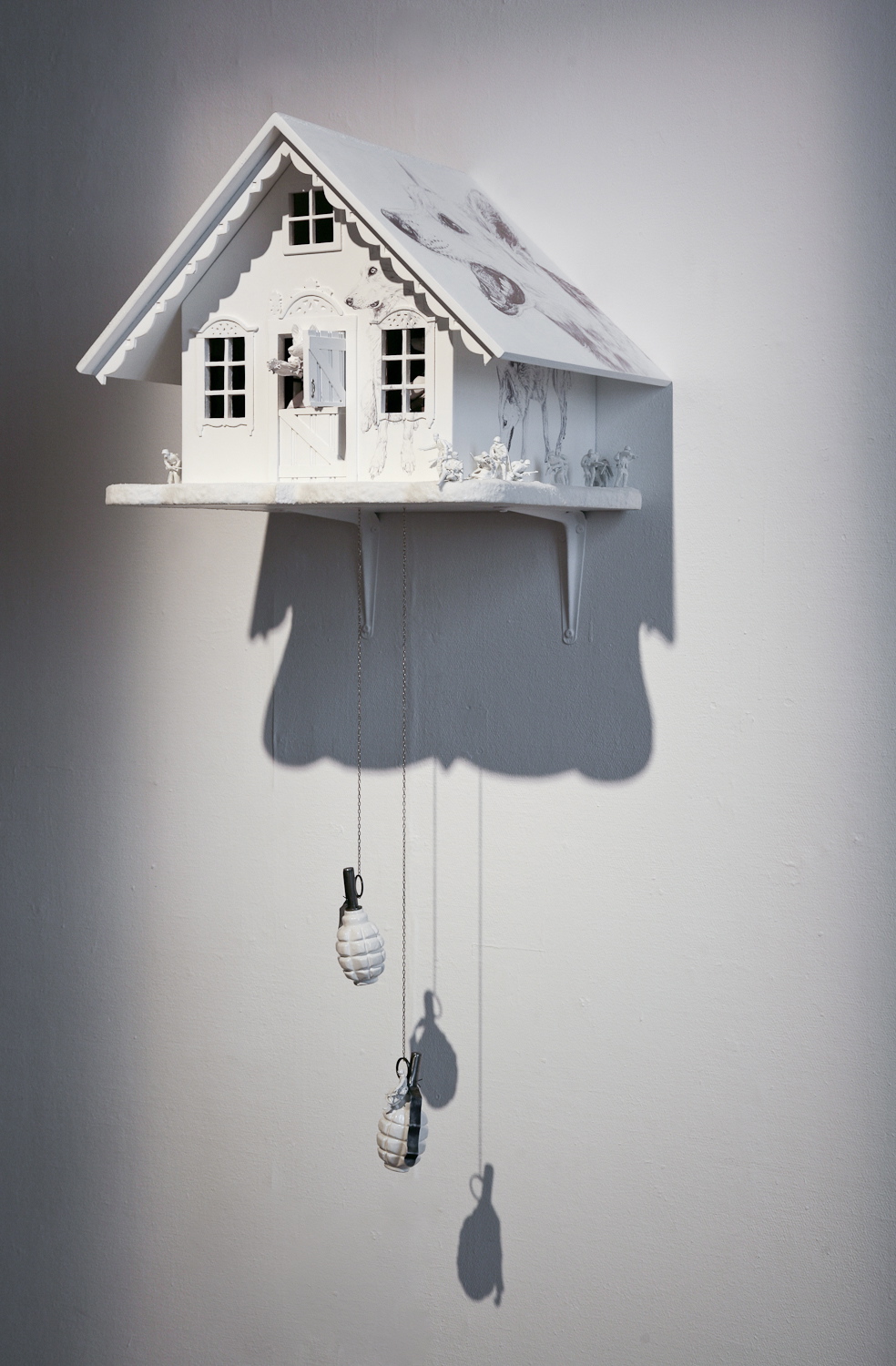
"The Wolf's House", 2012, black Biro drawings and mixed media by Jane Lee McCracken

“The Wolf’s House”, 2012, black Biro drawings and mixed media by Jane Lee McCracken

Outside a white-out blizzard howls, while war is waged through it.  Mrs Wolf throws open the door of ‘The Wolf’s House’ and looks out at the soldiers fighting around her cottage.

‘The Wolf’s House’ is symbolically one of the simplest pieces I have created for it simply asks “who is more civilised, man or animals?”.  A take on the iconic cuckoo clock, it was inspired by a cuckoo clock my father brought back to Scotland for me after a trip to Switzerland, when I was a child.

Black Biro drawing of Lily and 'Mrs Wolf'.  'Mrs Wolf' is made from a cast taken of wolf's head from my wedding cake-topper and the body of a vintage Polish Capeila doll as is 'Mr Wolf' who sits by the window.

Black Biro drawing of Lily and ‘Mrs Wolf’. ‘

The piece explores the juxtaposition of the roles of man and animals suggesting the idea of the ‘innocent’ instinctive nature of animals as opposed to the cerebrally determined brutal nature of man.  ‘The Wolf’s House’ is a beacon of light representing civilised society whilst chaos reigns outside; but it is occupied by wolves not humans.

"The Wolf's House", 2013, 'The Woodcutter's Cottage' exhibition, The Mercer Gallery, Harrogate

“The Wolf’s House”, 2013, ‘The Woodcutter’s Cottage’ exhibition, The Mercer Gallery, Harrogate.

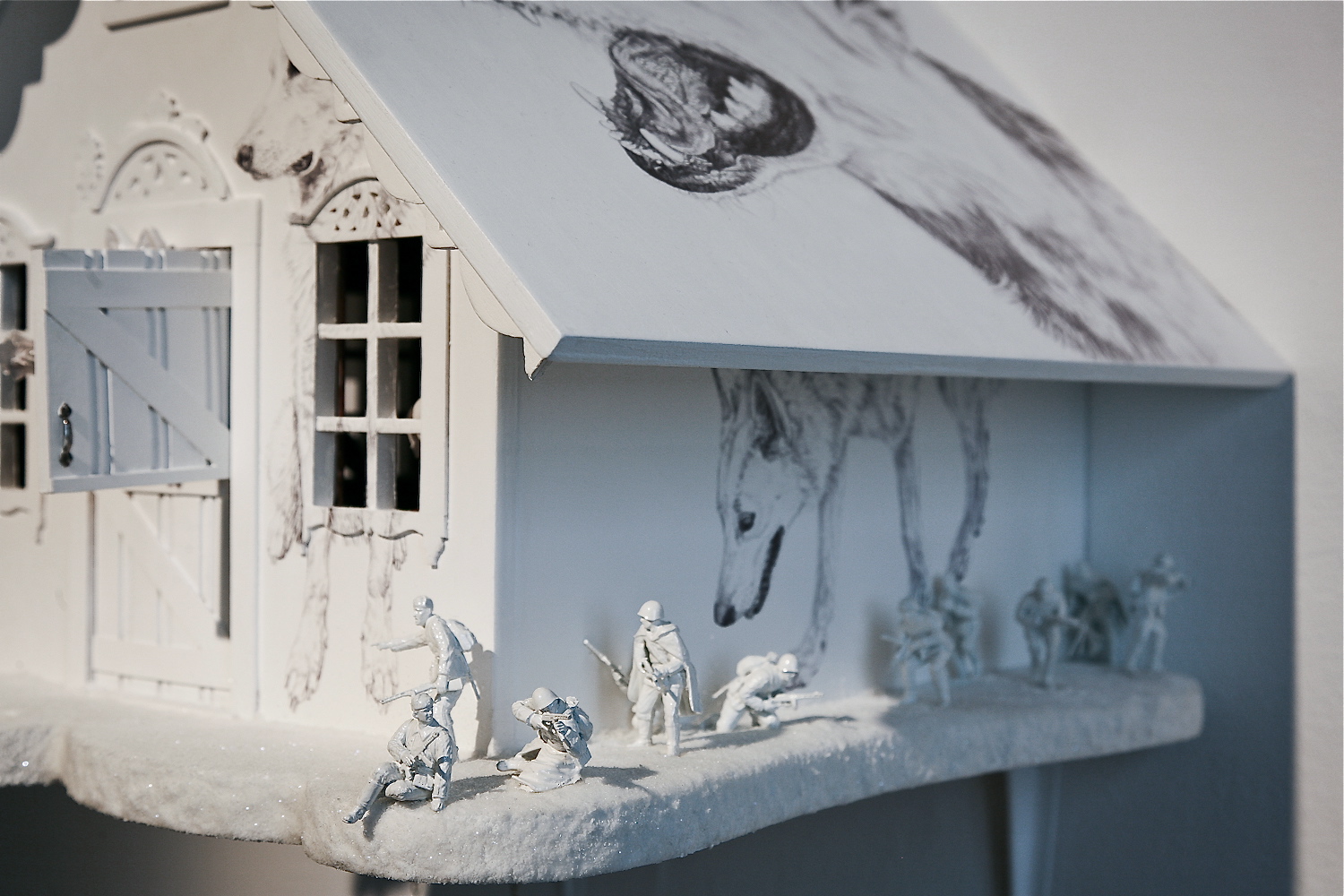
Soldiers fight in the snow around the Wolf’s House whilst Mr and Mrs Wolf witness war, as animals of the forest play peacefully inside the house.  However there is an ever present threat from humans.

'The Wolf's House' roof detail, black Biro drawing of Lily on painted MDF

‘The Wolf’s House’ roof detail, black Biro drawing of Lily on painted MDF

Further inspiration for the piece came from a photograph of Russian soldiers fighting through a village towards Germany after the end of the battle of Stalingrad when the tide of war has changed.  I imagined a cottage somewhere in Eastern Europe encircled by soldiers fighting a brutal war.

Official USSR photograph of Red Army in combat WWII, Artist's own collection.

Official USSR photograph of Red Army in combat WWII, Artist’s own collection.

‘The Wolf’s House is a mixed media piece which includes original black Biro drawings of Lily drawn on painted, sanded MDF.  Model railway snow and glitter were used to create the winter snow scene on the roof and base.  Printed transfers on fabric formed the wallpaper of the interior walls, complete with propaganda posters specifically designed for the piece.  I sourced replica Russian F1 hand grenades which were then painted with white enamel as were the model soldiers, German Assault Infantry in winter gear and Russian Army Assault Infantry.  An authentic cuckoo clock chain bought from a clock shop holds the hand grenade weights of the clock.  ‘Mr and Mrs Wolf’ were made from casts taken of the wolves heads from my wedding cake-topper and the bodies of vintage Polish Capelia dolls bought on Ebay.

'The Wolf's House' interior

‘The Wolf’s House’ interior

Mr Wolf sits by the window surrounded by propaganda posters and watches bears, a wolf, a fox and a tiger cub playing together.

'The Wolf's House' interior shot through window.

‘The Wolf’s House’ interior shot through side window.

'The Wolf's House' interior shot through front window.

‘The Wolf’s House’ interior shot through front window.

Their play indicates that each species has it’s own social structure and behaviour which is rarely disregarded but whilst humans have a highly developed sense of morality, the moral codes by which we live are often breached.

'"Save Us!', Propaganda poster for the Wolf's House, photo montage by Jane Lee McCracken

‘”Save Us!’, 2012, Propaganda poster for the Wolf’s House, photo montage by Jane Lee McCracken

Ultimately the futures of many species’ are held in our hands and this is symbolised by ‘The Wolf’s House’ and the ever present battle around the house and its occupants.

Russian model soldiers fighting in the snow around 'The Wolf's House'

Russian model soldiers fighting in the snow around ‘The Wolf’s House’

Luxury Archival Pigment Prints of ‘Save Us!’ made by the excellent Jack Lowe studio are available to order from my website

'"Save Us!', Propaganda poster for the Wolf's House, photo montage by Jane Lee McCracken

‘”Save Us!’, Propaganda poster for the Wolf’s House, Archival Pigment Print

Take One Puppy, her First Bed and a Proud Nation of Animal Lovers!

'Lily' aged 15 weeks during the photo shoot for 'The Red Horse and the Wolf Cub'

‘Lily’ aged 15 weeks during the photo shoot for ‘The Red Horse and the Wolf Cub’, 2007

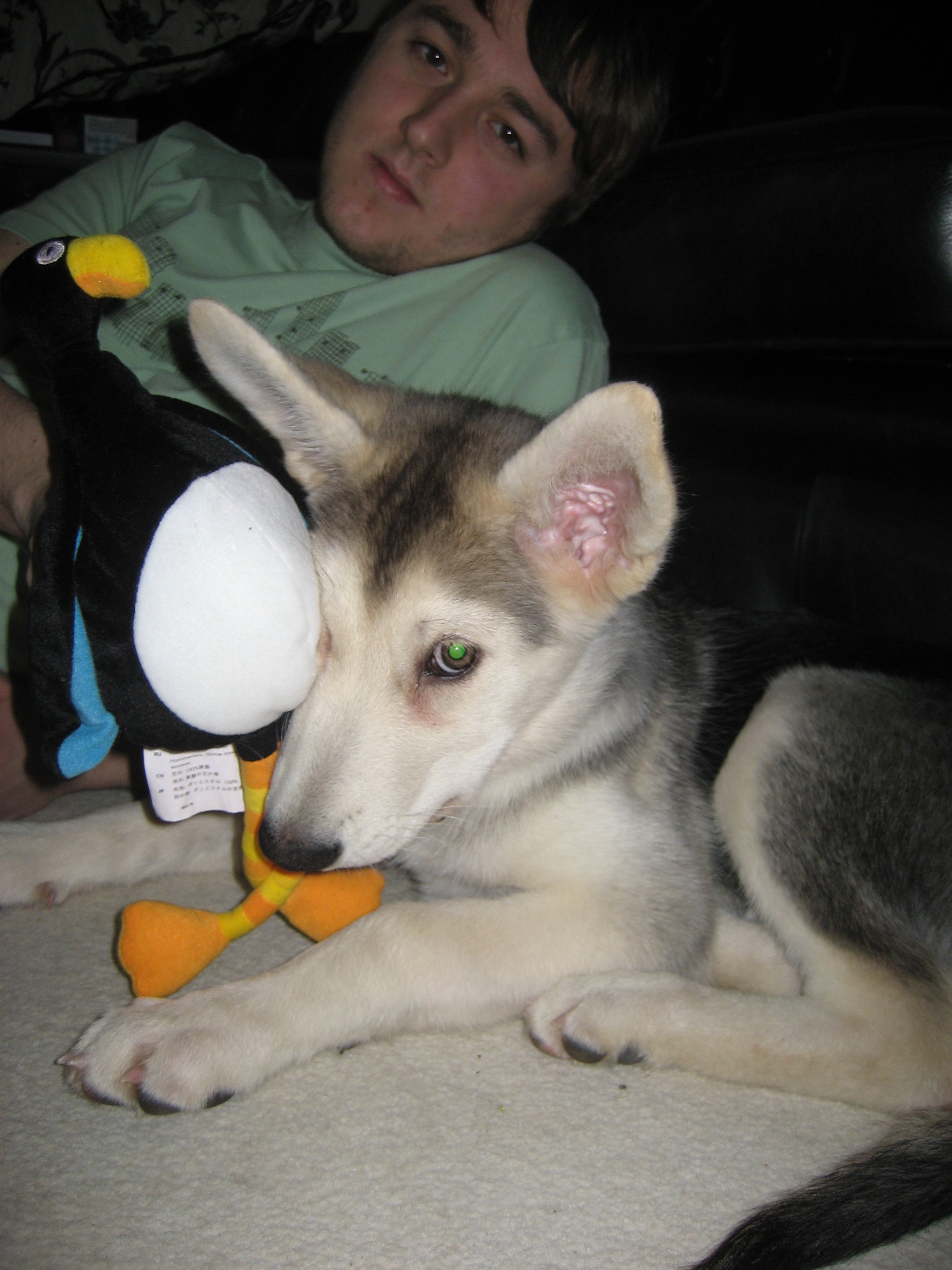
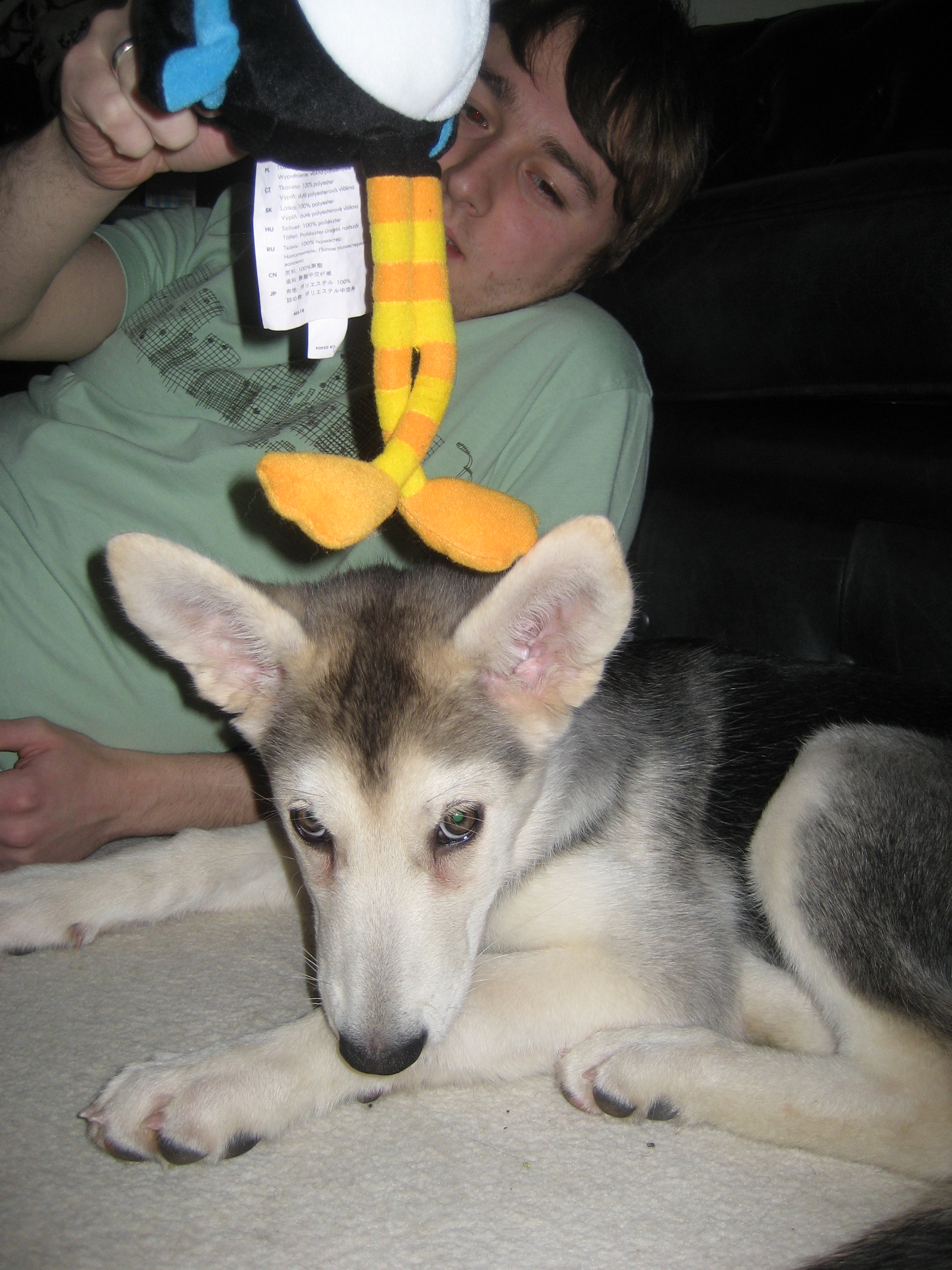
For all those who requested to see the photo-shoot of Lily for the drawing ‘Red Horse and the Wolf Cub’ – here it is in brief!!

Lily on location relaxing during the shoot!

Lily on location relaxing during the shoot!

Lily’s first bed was a red velvet affair with gaudy gold tassels – we called it her ‘Princess Bed’ as it reminded us of the fairy tale ‘The Princess and the Pea’ (for all us children of the 70’s, remember the Ladybird edition of the tale and those fabulous illustrations?).

Lily is given Pengy as a gift for her hard work modelling.

Lily is given Pengy as a gift for her hard work modelling.

She loved her wee bed!  Sadly it went the same way as the demise of ‘Pengy’, reduced to a small rag of red velvet!  Pengy was latterly known as ‘Pengy’s Foot’ when Lily realised she had teeth and would use them!  Sid from Toy Story would have been be proud of her.

"I have teeth woo hoo!"

“I have teeth woo hoo!”

"I'm getting bored and sleepy now!"

“I’m getting bored and sleepy now!”

Pengy’s foot resides somewhere in the dark recesses of Lily’s toy box!  Yes Lily has a toy box – for all you cynics out there who can be heard saying ‘typical childless person treating her dog like a baby!’ dogs are intelligent enough to differentiate between their toys and Lily knows each of her many (hence the need for a toy box!) toys by name and can often be found rooting around in her toy box looking for the particular mutilated creature she wants to play with at 5 o’clock sparrow am.  I always see play as an important part of Lily’s daily routine as it keeps her young at heart.  And can she play!

"I'm tired of the camera flash now!"

“Shh, Lily’s asleep!”

On a serious note many people, whether they have children or don’t have children, sadly or contentedly, or are dog or animal lovers, experience a strength of love for their dog that equates to the love of a family member because dogs are intelligent, pack animals with similar character traits to humans and therefore respond positively to love and affection.

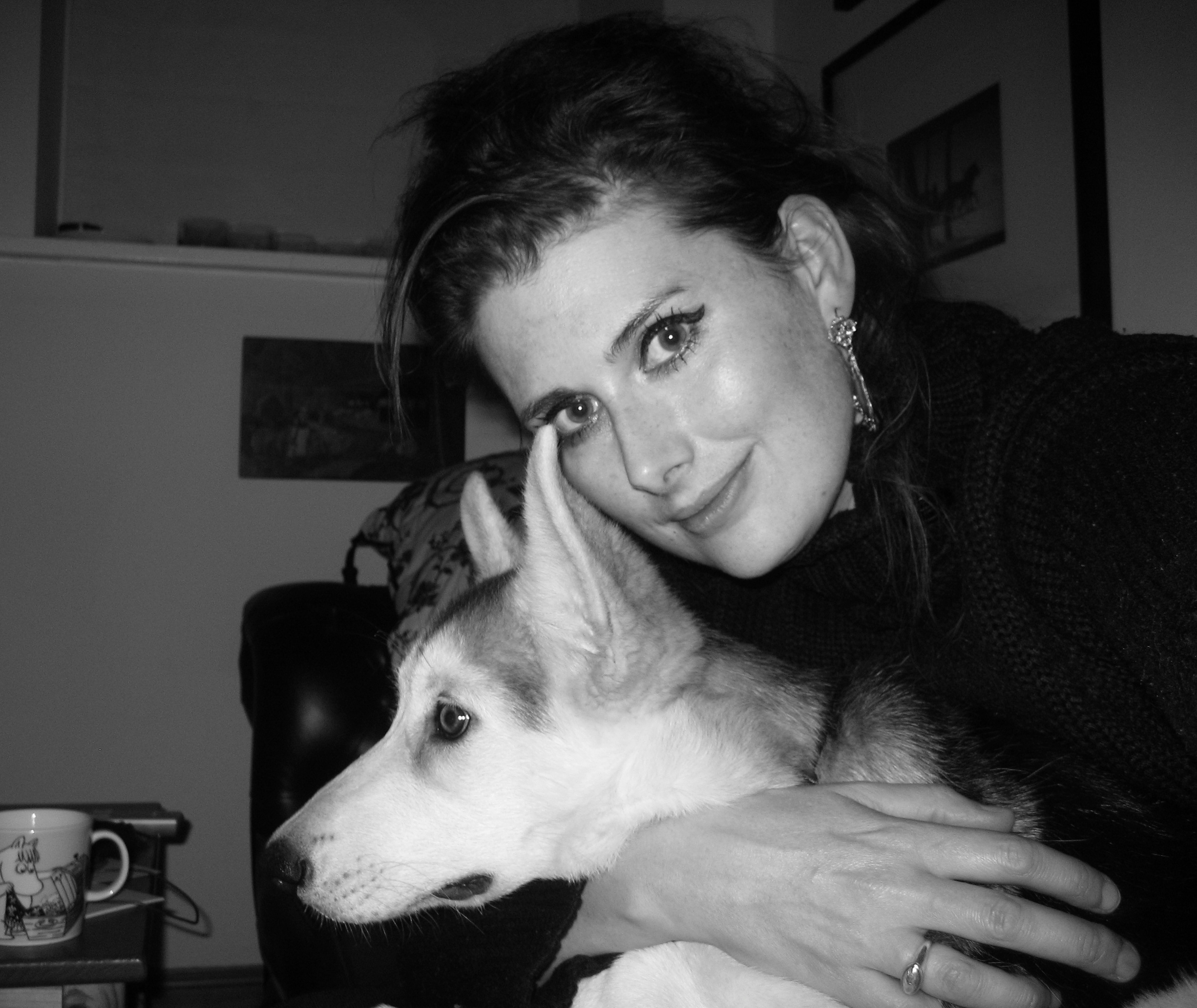
Me and Lily, 2007

Me and Lily, 2007

And what the hell if there are many of us out there who love our dogs like children – they are after all as innocent and reliant upon us, in my opinion as a child is and to give dogs a happy, loving home is surely what they deserve after the legacy we have created through domesticating canines.  Should we not celebrate and promote positively that many of our species share an empathy with and a love for animals? Such empathy defines a nation as a compassionate modern society and a nation of animal lovers is something to be proud of.

Lily and me, 2007

Lily and me, 2007

“The greatness of a nation and its moral progress can be judged by the way its animals are treated   Gandhi

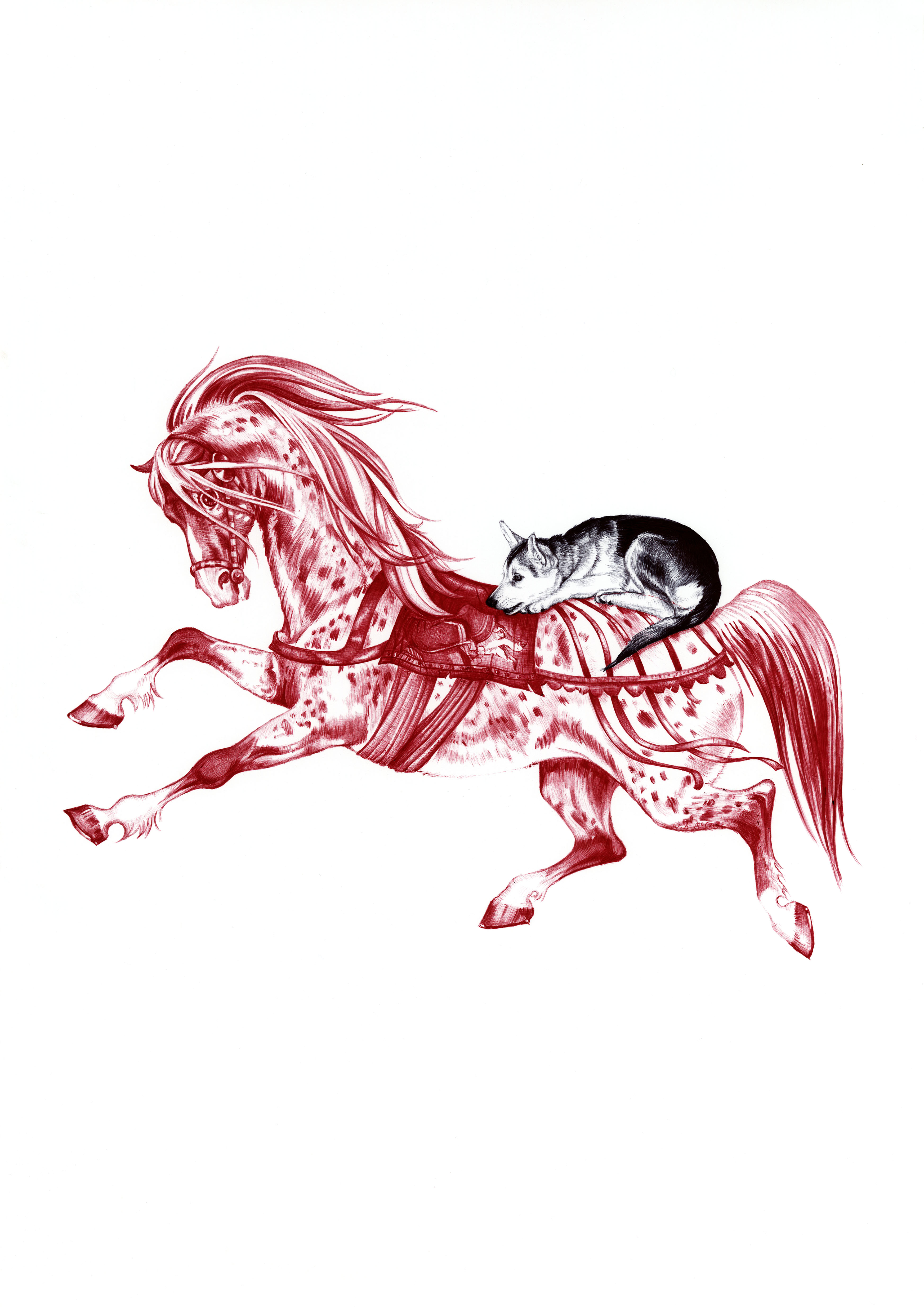
'Red Horse and the Wolf Cub - After Janet and Anne Grahame Johnstone', 2009, red and black Biro drawing by Jane Lee McCracken

‘Red Horse and the Wolf Cub – After Janet and Anne Grahame Johnstone’, 2009, red and black Biro drawing by Jane Lee McCracken

And this is the result of the photo shoot, Lily as the ‘Wolf Cub’.

Limited Edition Luxurious Archival Pigment Prints of the ‘Red Horse and the Wolf Cub’ crafted by one of the best printmaker’s in the UK Jack Lowe Studio are available from my website

DERBY DAY in Newcastle with the TOON Army – Street Food at the Grainger Market

Mounted Police at St James's Park,  Newcastle

Mounted Police at St James’ Park, Newcastle

This year my birthday luckily fell on one of the two most significant dates in any Newcastle United or Sunderland Football Club fans calendar – Derby Day!

As a birthday treat, mon chéri and I decided to go into town for the day and catch the match in a pub, tickets for the game had long since sold out.  Let me explain the word ‘treat’ in association with the words ‘go into town’, something a lot of people take for granted as a weekly or at least monthly staple. Lily can never be left on her own, EVER.  Northern Inuits as a breed are pack dogs, and left alone they suffer from severe separation anxiety.  People often comment on our situation ‘Oh it’s just like having a baby” – you can put a nappy on a baby! And unlike France, the Great British service industry does not welcome with open arms into their shops and restaurants, canines.  So going out is a rare occasion and a well planned exercise in sorting out Lily care.  We wouldn’t have our lives any other way though, we love Lily!
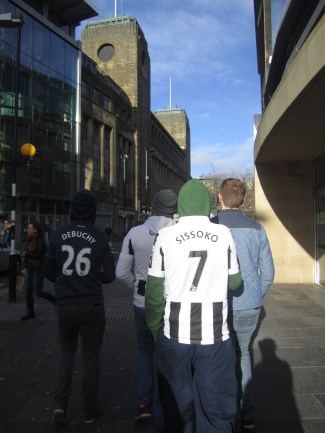
Debuchy and Sissisko on their way to the Newcastle United changing rooms at St James's Park

Debuchy and Sissoko on their way to the Newcastle United changing rooms at St James’ Park

On a gloriously sunny February Saturday in Newcastle city centre, we walked the historic streets on the great pilgrimage to St James’ Park, sailing along on a sea of black and white shirts, literally in the honorable footsteps of Debuchy and Sissoko, obviously on their way to the home changing rooms.

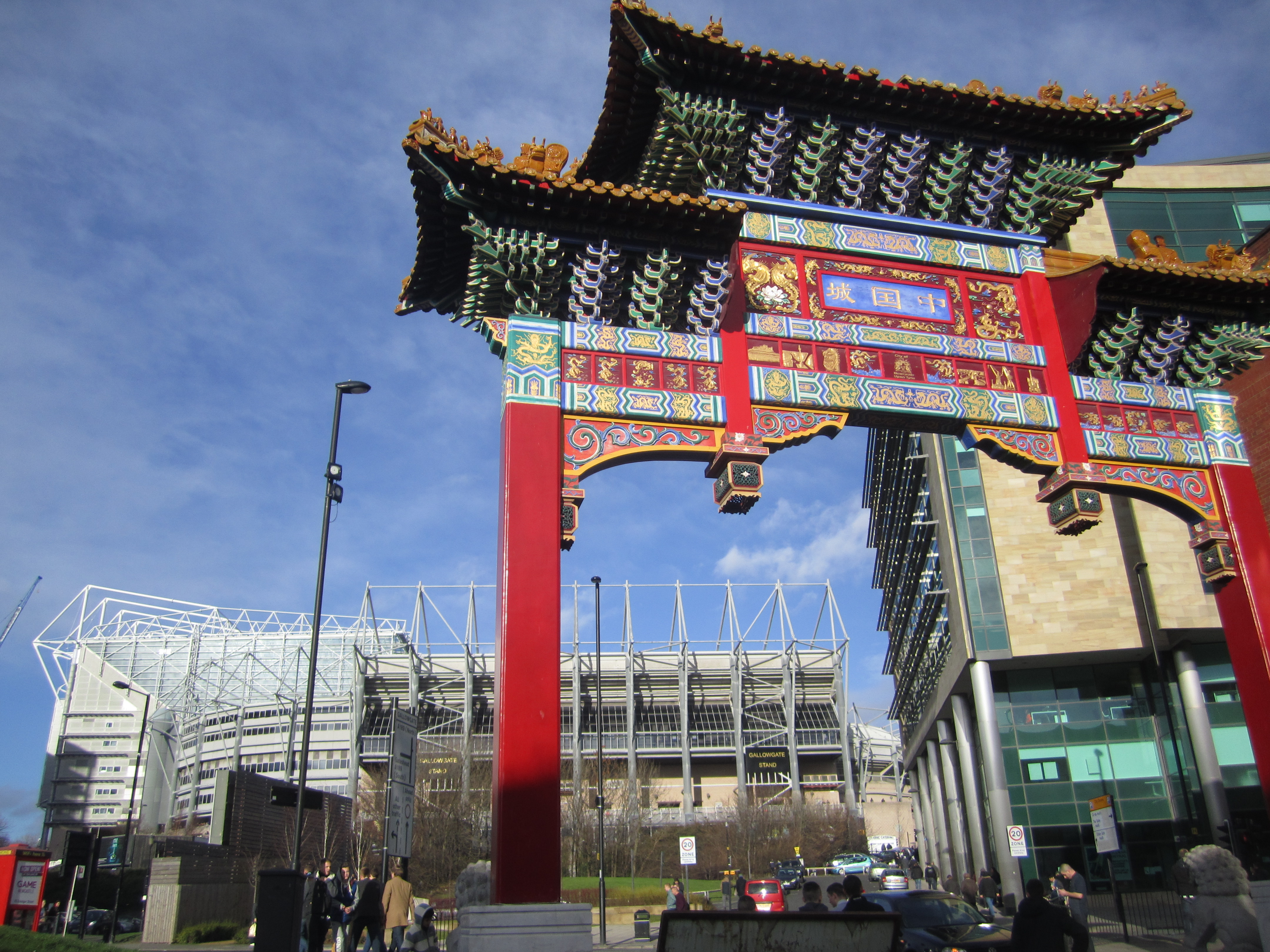
Newcastle United's epic stadium St James's Park near Chinatown

Newcastle United’s epic stadium St James’ Park near Chinatown

There wasn’t a ‘Black Cat’ fan in sight.  That’s because the rivalry between ‘Magpie’ fans and Sunderland fans is so fierce that they have to be escorted to the turnstiles by an army of police to prevent a mortal battle outside Newcastle United’s epic stadium.  The Geordies ‘Mackem’ brethren only live some 13 miles down the coast from Geordieland but c’est la vie of football fans – rivalry is everything!  Incidentally for all those who are not familiar with the term ‘Mackem’ it is a proud historic name given to a son or daughter of the City of Sunderland.  The rivalry between Geordies and Mackems originates in the phrase ‘Mackem and Tackem’ (Make them and Take them), terminology from the 19th century and the North East’s famous ship building heritage.  Wearside ship builders were said to ‘Mackem’ – ‘make the ships’ and Tyneside ship builders were said to ‘Tackem’, ‘take the ships’ hence the name ‘Mackem’.    Rivalry aside, what is so wonderful about the football heritage of both Newcastle and Sunderland is that there is only one top league club in each city so pride is solely devoted to one club, leading to unrivalled camaraderie and ‘brothers in arms’, unlike the divided families of Manchester and Liverpool.

Mounted Police outside Shark's Bar, Newcastle

Mounted Police outside Shark’s Bar, Newcastle

The police presence was monumental outside St James’ park as we headed to our classy port in a storm, Shark Club!  Mounted police on majestic, horses wearing protective armour, stood in a row, a policewoman even smiled down from the back of her beautiful 17hands mount, as I took her photo, the excitement of the ‘Toon Army’ fans was infectious.  Swallowed like sardines into the shark’s stomach of the bar, we drank and awaited with intrepid anticipation for the match to be televised on the hundreds of screens around the bar.  Nowadays refreshingly, there are many more female fans at the match and in the bars enjoying the game.  My best pal’s mum was probably at the match, training it down on the Flying Scotsman from Edinburgh for the day; she has been a die hard fan since a wee girl!  Curiously though, you don’t see female fans joining in the war chants like ‘Shoot the Mackems, Shoot, Shoot the Mackem’s’ that raised the roofs of the bars en route to St James’ Park Stadium as the Sunderland fans walked past like captured soldiers on their way to a gulag!  The bouncer eventually put a stop to the battle cries in our pub!
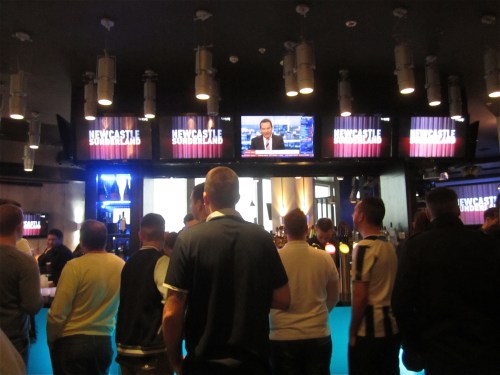
The Newcastle United v Sunderland FC match about to start, Shark's Bar, Newcastle

The Newcastle United v Sunderland FC match about to start, Shark Club, Newcastle

Newcastle fans were nervous as well they might be, Newcastle have never lost three times in a row to a post 1920s Sunderland team but the last two derby day fixtures have seen a Sunderland team in an around the relegation zone beat Newcastle twice!  So tension was in the lager air around us.  Dreamboat Cabaye, arguably Newcastle’s best player was sold earlier in the week so with their talisman and captain now in gay Paris, the team looked lost both in direction and effort.  An illegal tackle in the penalty box by Anita on Sunderland’s Bardsley resulted in a penalty scored by Borini. A deflection off Sunderland’s Johnson saw a second goal in the first half and a third goal from Sunderland’s Colback after 80 minutes saw United fans leaving the stands in their droves before full time, furious at yet another poor result against their arch rivals.  Drawing the curtains on the Transfer Window on Transfer Deadline Day on Friday, Newcastle made no permanent signings, their only business Luuk De Jong, signed on loan.  Reportedly at the urinals, fans were calling for blood, sacking of Newcastle manager Alan Pardew, banishment of Joe Kinnear from the club and top of the blood feud list owner Mike Ashley to be run out of town forever.  Perhaps the closing down of his flagship shop ‘Sports Direct’ in Newcastle’s Eldon Square is a hopeful sign that he might be leaving the Toon after all?  Pardew cut a lonely and forlorn figure as the fulltime whistle blew.  Maybe he is as frustrated with the owner as the fans are?  Oh god another depressing result and the doom and gloom of the forensic autopsy of the game, the manager and the players.  I always tend on the side of optimism, but this seems to rub mon mari Toon fan up the wrong way!

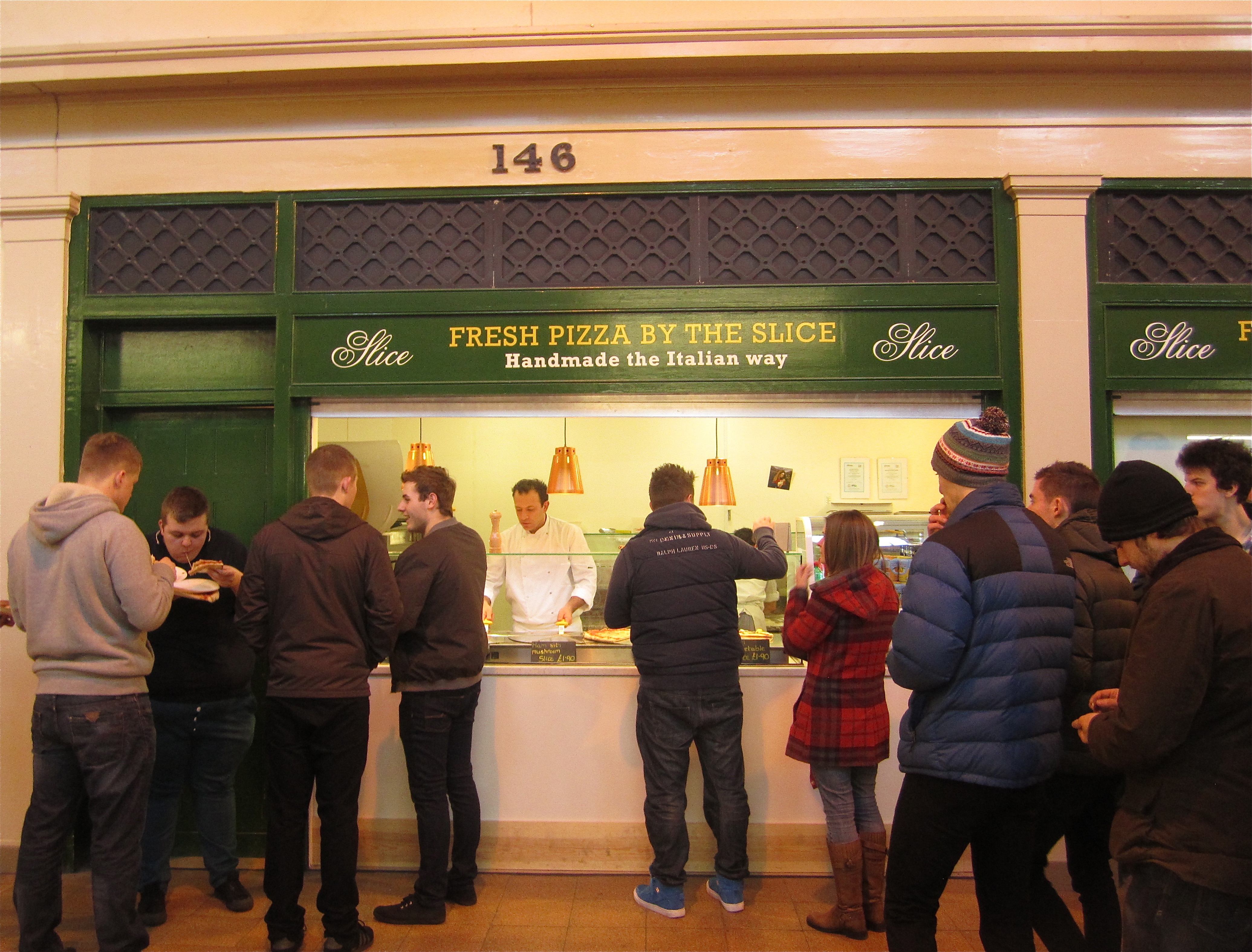
'Fresh Pizza by the Slice' stall in the Grainger Market, Newcastle

‘Fresh Pizza by the Slice’ stall in the Grainger Market, Newcastle

Never mind there was still my birthday to celebrate?! The gorgeous Grainger Market shone through the gloom, a Victorian indoor market where the smallest branch of Marks and Spencer’s, a stall over 125 years since opened, resides.  What could be better to comfort the soul of a bruised Toon fan than a slice of pizza from ‘Fresh Pizza by the Slice’, who make the best pizzas in town – delicious, thin, crispy base and gorgeous toppings – and for the die–hard fan’s wife and fellow Toon fan, a box of the most delicious deep-fried calamari complete with lemon slice and stottie quarter with real butter at the gorgeous ‘Simply Seafood Lindsay’s to Go’ stall.

'Simply Seafood Lindsay's to Go', freshly cooked seafood stall, Grainger Market, Newcastle

‘Simply Seafood Lindsay’s to Go’, freshly cooked seafood stall, Grainger Market, Newcastle

I cannot recommend both of these stalls highly enough for any visitors coming to Newcastle – street food is in vogue and these stalls are on trend with excellent, reasonably priced street food.  But Lindsay’s just tipped the scales for me on Derby Day.  An experienced fishmonger shucks fresh oysters which are served with vodka, lemon, and Tabasco, whilst a talented chef cooks fresh spicy noodles with mixed seafood in a hot wok before your eyes and the result is the best box of noodles in town – and the calamari?  The batter is the lightest, crispiest and tastiest I’ve ever had – give it a go!

Fresh oysters at the Grainger Market, Newcastle

Fresh oysters at the Grainger Market, Newcastle

All that was left to do after a late luncheon feast was to drink cocktails, a Violet Maritini for me in the popular Popolo’s Bar and a Sitting Bull in lovely Alvinos Bar amongst the excellent Street Art exhibited on Alvinos walls.  Followed by a superb dining experience at the wonderful Dabbawal’s on High Bridge producing the best Indian street food in town and my birthday treat courtesy of my wonderful husband was complete, apart from a sleepy Metro journey home and a catch up with three episodes of Family Guy – another year older but who cares when you can celebrate it in style on Derby Day!

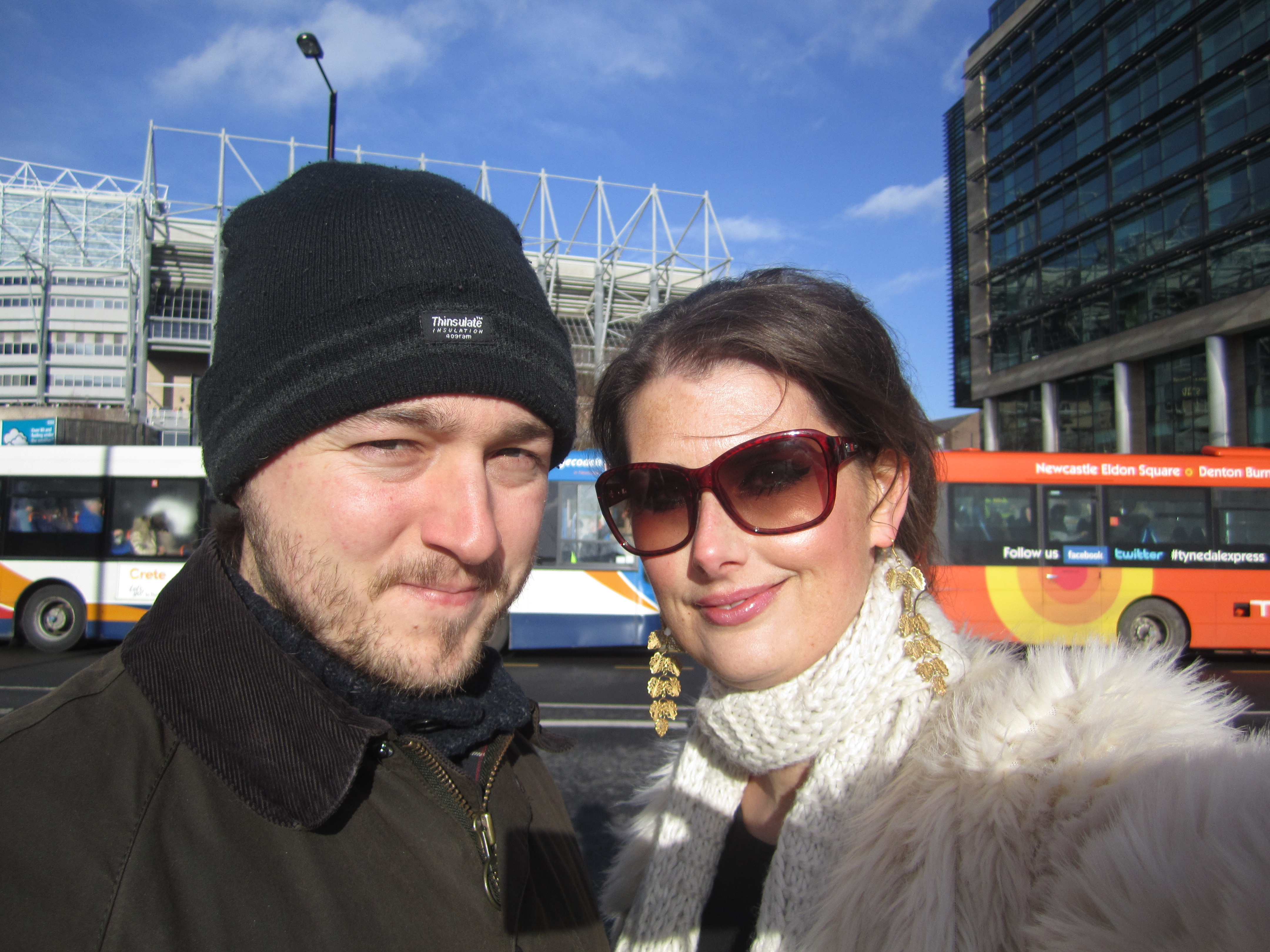
Selfie Greeting's from Newcastle on Derby Day!

Selfie Greeting’s from Newcastle on Derby Day!

NB.  A birthday greeting from a dear Geordie friend saw a ‘very’ satirical reflection of our day unless I really do look like Waynetta, dear friend?!

“Despite the seasonal chill, various celebs were spotted at St James’ Park today for the Newcastle – Sunderland Premier League match.  International football shirt tycoon Rob Lee was there with his international artist wife, Jane. Jane was in a fetching cerise shell suit (more vintage, eh?), lemon Jimmy Choo sneakers (again, dare we say, probably a rip-off from top Primark designers), and a black fun-fur jacket. And talk about show-stoppers!  Her trademark super-size hoop earrings kept catching the wind, and the noise was mistaken for the ref’s whistle, disrupting play no less than seven times.  Some red faces there, we’ll bet! Rumour has it it’s her birthday!  Good on ya, Rob, for knowing how to treat a girl!”
The Transylvanian Miller, her Two Sons and ‘The Red Horse and the Wolf Cub’

'Red Horse and the Wolf Cub - After Janet and Anne Grahame Johnstone', 2009, red and black Biro drawing by Jane Lee McCracken

‘Red Horse and the Wolf Cub – After Janet and Anne Grahame Johnstone’, 2009, red and black Biro drawing by Jane Lee McCracken

Not Long Ago, there lived a Miller and her two sons in a watermill, in a hamlet near the Transylvanian village of Miklósvár.  The mill was the prettiest building in the hamlet with the most beautiful cottage garden and chickens clucking through the flower beds.  Although she was very old and very petite the Miller ran the mill as she had for many years with the help of her sons.  Her sons had the bluest eyes in the land and were very tall.  All she needed was contained in one small, dark room, her bed, her kitchen range, a table, a chair and her loom for weaving tapestries and rugs.

The Miller's room at the watermill, Transylvania, 2008

The Miller’s room at the watermill, Transylvania, 2008, Jane Lee McCracken

Sometimes she welcomed travellers to visit her mill to make extra leu.  One day a Scottish visitor and a Geordie visitor came to the mill.  She had baked them fresh pastries with jam which were delicious.  Her sons showed the visitors how the mill and its water wheel worked, then the Miller allowed the Scottish visitor to try weaving a rug on the loom.  Whilst weaving the visitor noticed a vibrant tapestry, hanging on the wall above the bed.  The tapestry depicted a fairy tale and underneath it the Miller sweetly slept in her bed each night.  When the tour was over the Miller stood in her garden in the sunshine waving goodbye to the visitors and her sons blinked their bright blue eyes”.

Wolf-tracking, Transylviania, 2008

Wolf-tracking, Transylviania, 2008, Jane Lee McCracken

So many aspects of our trip to Romania in 2008 have stayed with us, the breathtaking landscapes, the beautiful villages, wolf-tracking, bear-tracking and the friends we made and two wonderful nights spent with them in The Shed – a glorious watering hole in a Transylvanian village.

The Geordie and commonly known by himself, "George Bush",  The Shed, Transylvania, 2008

The Geordie and commonly known by himself, “George Bush”, The Shed, Transylvania, 2008

And the Miller and her mill.  I never forgot her standing in her garden waving to us.

The Miller's garden, Transylvania, 2008

The Miller’s garden, Transylvania, 2008, Jane Lee McCracken

During our Romanian adventure, partly in the footsteps of Patrick Leigh Fermor, (see 175 Steps with Patrick Leigh Fermor) we learned a lot about Communist oppression of the Romanian people, Communist State Terror and the purges resulting in many thousands of  lives lost at the hands of the Securitate – the Romanian Secret Police.  A tragically broken country and people, Romania only emerged from the shadow of Communism and Nicolae Ceaușescu’s regime in 1989.

Cottage in mountain village, Transylvania, 2008

Cottage in mountain village, Transylvania, 2008, Jane Lee McCracken

Remembering the Miller and her precious fairy tale tapestry, I thought of the communist purges and the Romanian peoples forcibly torn from their homes by the Securitate and the possessions left behind in the many empty properties we saw across Romania, grave memorials of the state’s barbarity.

'Join the Red Army', 1920 Ukrainian recruitment poster, artist unknown

‘Join the Red Army’, 1920 Ukrainian recruitment poster, artist unknown

To commemorate such loss during the purges I decided to make ‘The Red Horse and the Wolf Cub’.  It represents an interpretation of mass produced prints made in the 20th century of a fictional fairy tale about a ‘wolf cub’ and a ‘red horse’ and is reminiscent of Soviet Propaganda posters.  The drawing signifies how subjective art is and once selected by an individual, and displayed in their home it becomes a statement of ‘this is my taste’.  When the art work is left behind on the walls of abandoned homes, the home-owners ‘taste’ is exhibited to a silent audience or rediscovered by soldiers, refugees, other villagers or by nature.  The drawing also pays homage to Ivan Bilibin’s illustrations, particularly ‘The Red Rider’ in the Russian tale “Vasilisa the Beautiful”.

'Red Rider', "Vasalisa the Beautiful", Ivan Bilibin, 1899

‘Red Rider’, “Vasalisa the Beautiful”, Ivan Bilibin, 1899

I wondered had the Miller loved fairy tales as a young girl just as I loved my first fairy tale book illustrated by Janet and Anne Grahame Johnstone.  Incorporating a drawing in red Biro of a gypsy horse after Janet and Anne Grahame Johnstone, one of my favourite childhood illustrations, I placed Lily as a puppy playing the wolf cub, riding on the horse’s back.  On the saddle is a projection of a Russian animation of a wolf which the wolf cub is watching.

'Lily' aged 15 weeks during the photo shoot for 'The Red Horse and the Wolf Cub'

‘Lily’ aged 15 weeks during the photo shoot for ‘The Red Horse and the Wolf Cub’

The drawing also memorialises our wonderful trip to beautiful Romania.

'Red Horse and the Wolf Cub - After Janet and Anne Grahame Johnstone', 2009, red and black Biro drawing by Jane Lee McCracken

‘Red Horse and the Wolf Cub – After Janet and Anne Grahame Johnstone’, 2009, red and black Biro drawing by Jane Lee McCracken

Luxurious Archival Pigment limited edition prints of ‘The Red Horse and the Wolf Cub’, made by the excellent Jack Lowe Studio are available from my website

‘You Can Lead a Horse to Water…’ – Béla Tarr’s ‘TURIN HORSE’ in Kraków

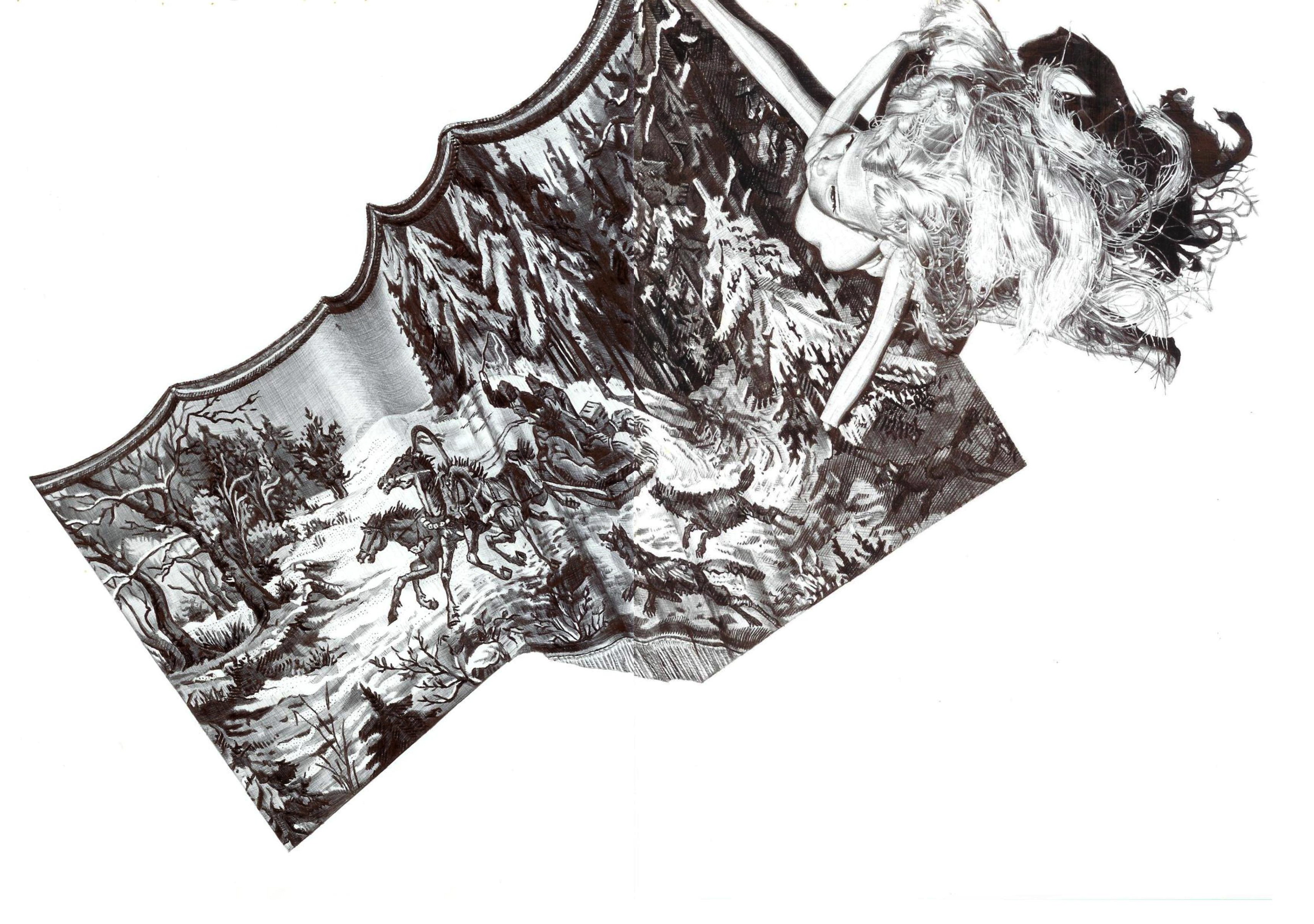
'Sindy and the Troika', black Biro drawing , 2008, by Jane Lee McCracken symbolises possessions left behind when people flee their homes during war or disaster.

‘Sindy and the Troika’, black Biro drawing , 2008, by Jane Lee McCracken

Incessant winda dirge of clawing violins on repeat… ’Doom’ on his hands and knees, crawling ever closer with each sunset, along his impending trail of inevitable cataclysm, until finally he reaches the desolate cottage on the Hungarian plains.

Bela Tarr’s finale to his epic film-making career ‘Turin Horse’ is a triumph of Apocalyptic cinema.  In the beginning: a black screen and Tarr’s voice narrating a vigil of white text informs us that on 3rd January 1889 in Turin, Friedrich Nietzsche reached out to protect a horse being beaten by its owner, experienced a terminal breakdown and lived a further ‘silent and demented’ 10 years until his death… “We do not know what happened to the horse.”

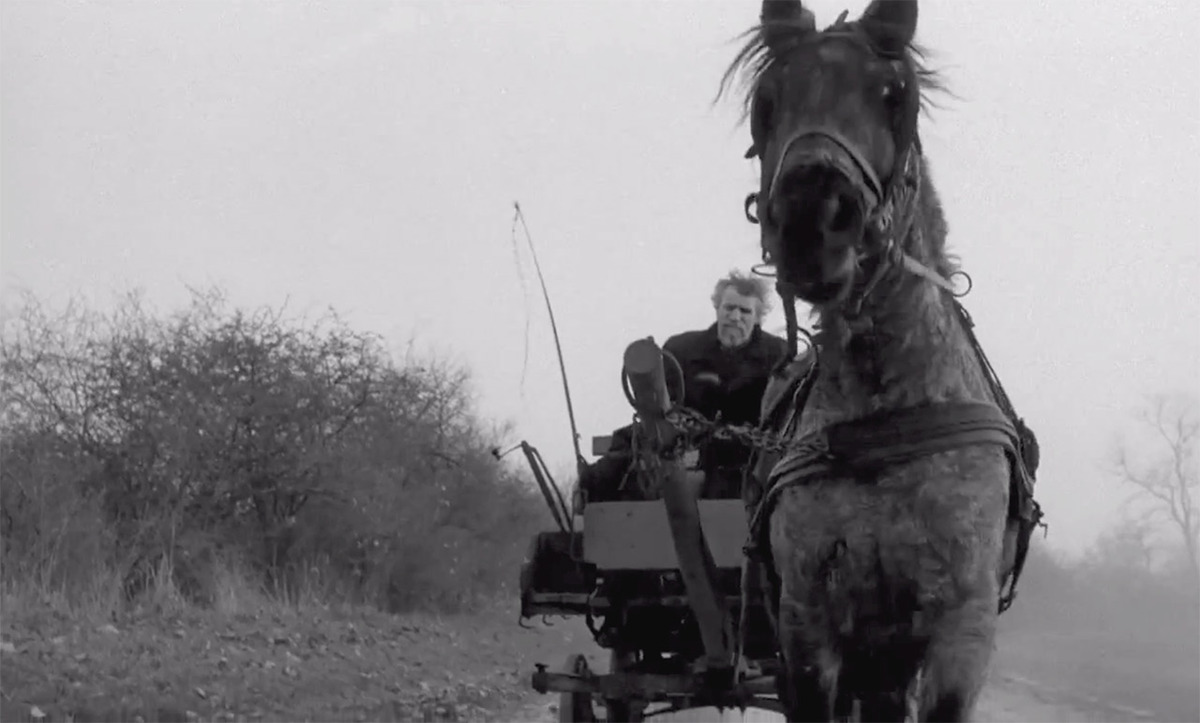
Opening scene, 'Turin Horse', Béla Tarr, 2011

Opening scene, ‘Turin Horse’, Béla Tarr, 2011

The Wind Blows Where it Wishes: an elderly man driving his horse and cart, battle through an abrasive gale along a country road, escorted by Mihály Víg’s vulturous score, reminiscent of Philip Glass’s composition for ‘Candyman’, until they finally reach an isolated cottage.  A woman steps from the shadows of a barn to help the old man unbridle the horse and lead it to stable and rest.  The bait is eaten as we are reeled in by our temptation to find out what happens next…not much and yet so much.  No names, no histoire and a minimalist script, Béla Tarr leaves us virtually at the mercy of the mesmerising, monochrome cinematography of Fred Kelemen.

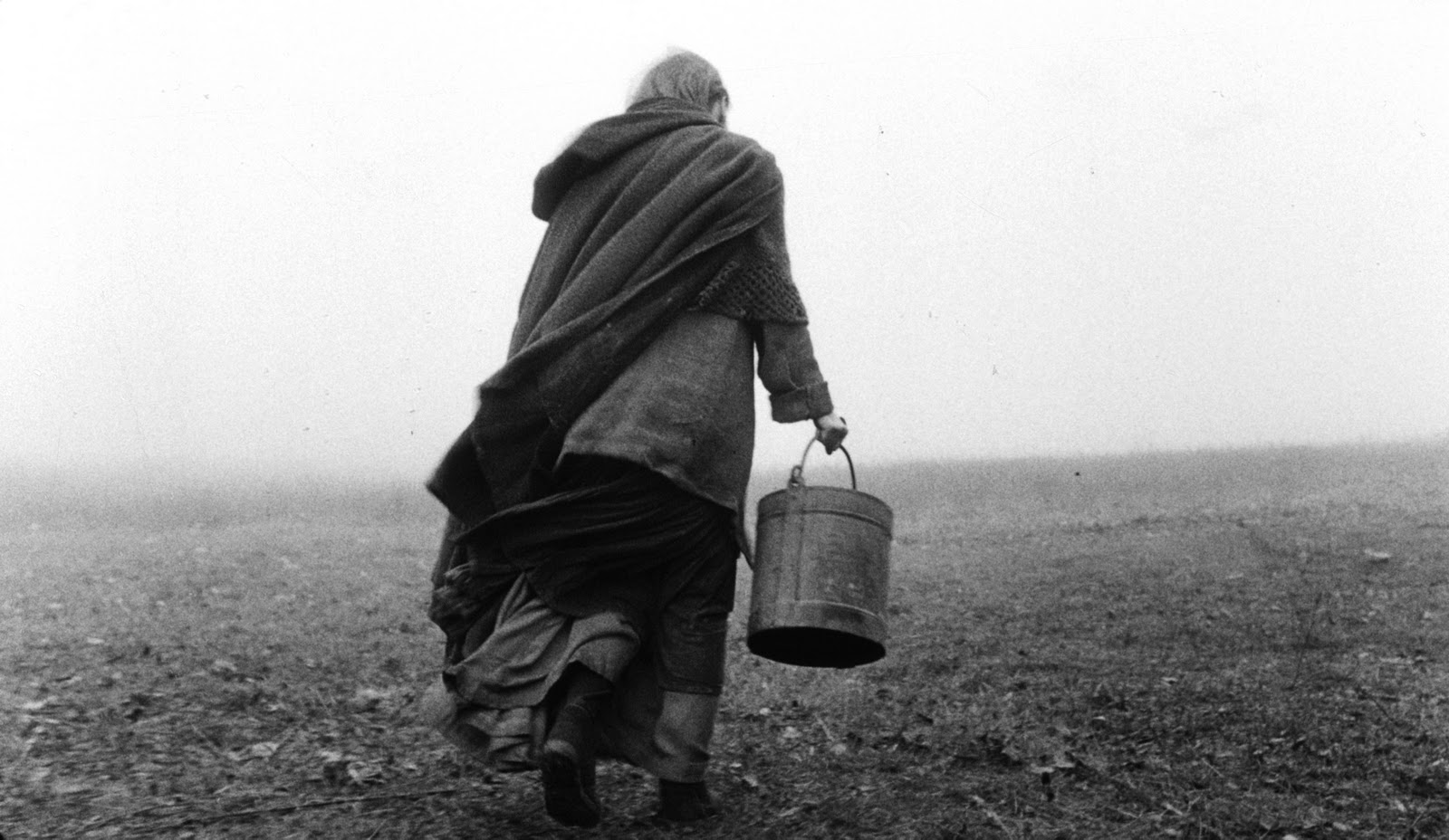
'Daughter' trudging to the well in 'Turin Horse', Béla Tarr, 2011

‘Daughter’ trudging to the well, ‘Turin Horse’, Béla Tarr, 2011

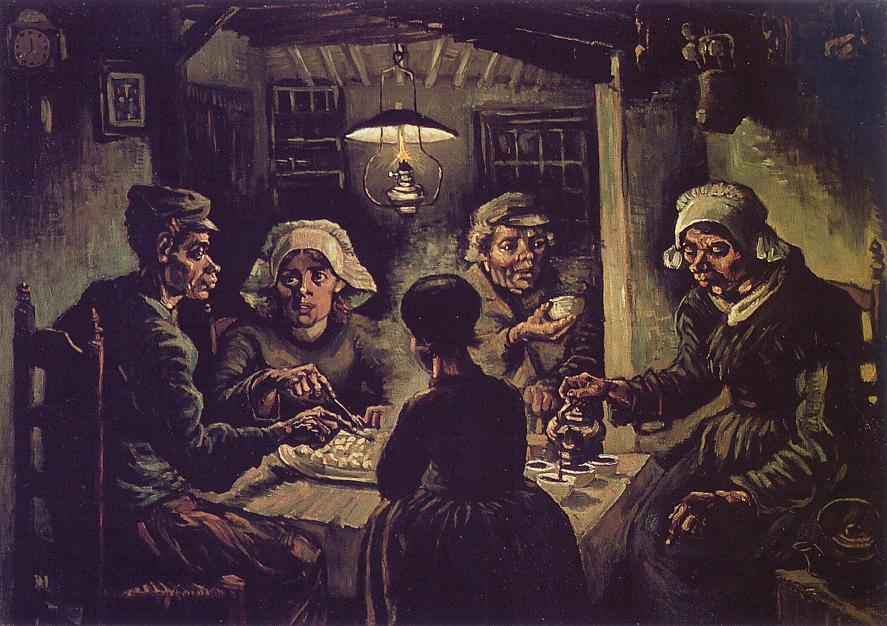
From the unbuttoning and buttoning of tattered clothes, folding of linen and the skinning by hand of hot boiled potatoes to reach the piping flesh; the daughter’s gruelling daily walk to the well in the prophetic wind to fetch water, we watch almost as if in real time 6 days of peasant hardship, grind and repetitive misery, that are the lives of an old man and his daughter in their dark, aged cottage whilst Abaddon rages outside.  Tarr’s appreciation of such adversity brings us perhaps as close as we can come to watching how our 19th century peasant forebears lived, and is almost the triumph of the film.  In parallel, Tarr’s vision gives us what Van Gogh gave us with ‘The Potato Eaters’ a wish to spare us nothing,

'The Potato Eaters', Vincent Van Gogh, 1885

‘The Potato Eaters’, Vincent Van Gogh, 1885

“You see, I really have wanted to make it so that people get the idea that these folk, who are eating their potatoes by the light of their little lamp, have tilled the earth themselves with these hands they are putting in the dish, and so it speaks of manual labor and — that they have thus honestly earned their food. I wanted it to give the idea of a wholly different way of life from ours — civilized people. So I certainly don’t want everyone just to admire it or approve of it without knowing why.”, Vincent Van Gogh“Letter 497”, The Letters, Van Gogh Museum, Amsterdam.

Almost the triumph of the film, but not quite.

Whilst the camera focuses on a black blizzard of bird-like leaves wheeling through the foreground, the father and daughter leading their horse, their well now empty of water, attempt to escape the world counting down to oblivion.  As their tragic out of focus figures wrestle along the distant horizon of a ridge with a single tree, I can feel the gentle breath from Lily’s canine nose on my hand as she lies beside me on the sofa. Like the quiet grace of the ‘horse’, Lily’s reassuring, measured breaths during that bleak scene reinforce the innocence humanity literally holds in its hands, a ‘key point’ of Tarr’s film.

'Horse', 'Turin Horse', Béla Tarr, 2011

‘Horse’, ‘Turin Horse’, Béla Tarr, 2011

And Darkness was on the Face of the Deep: The triumph of the film is the horse. Her dignity, the majesty with which her whole being seems to say ‘humanity you led us all to this, and now there is not even water to drink’.  The horse is our prophet, her intelligence far surpasses ours as she warns us life as we know it is over, that we have lost light and we are now plunging back into the darkness before creation, by man’s hand and Nature’s.

“The key point is that the humanity, all of us, including me, are responsible for destruction of the world. But there is also a force above human at work – the gale blowing throughout the film – that is also destroying the world. So both humanity and a higher force are destroying the world.” Bela Tarr, 2011

Bar in Kraków, 2007

Bar in Kraków, 2007

Watching ‘Turin Horse’ reminded me of a drawing I did in 2008 after a trip to  Kraków, ‘Sindy and the Troika’, which visited a theme I have often explored; fear and transpiration from the approach of a warring army.  We were staying in Kazimierz, which was once the heart of Jewish Kraków until the Nazis mercilessly ‘cleared’ the ghetto in WWII, depicted in Steven Spielberg’s film ‘Schindler’s List’, sending most of its Jewish inhabitants to their demise in nearby death camps like Auschwitz.

Kraków bar with Singer sewing machine as table, 2007

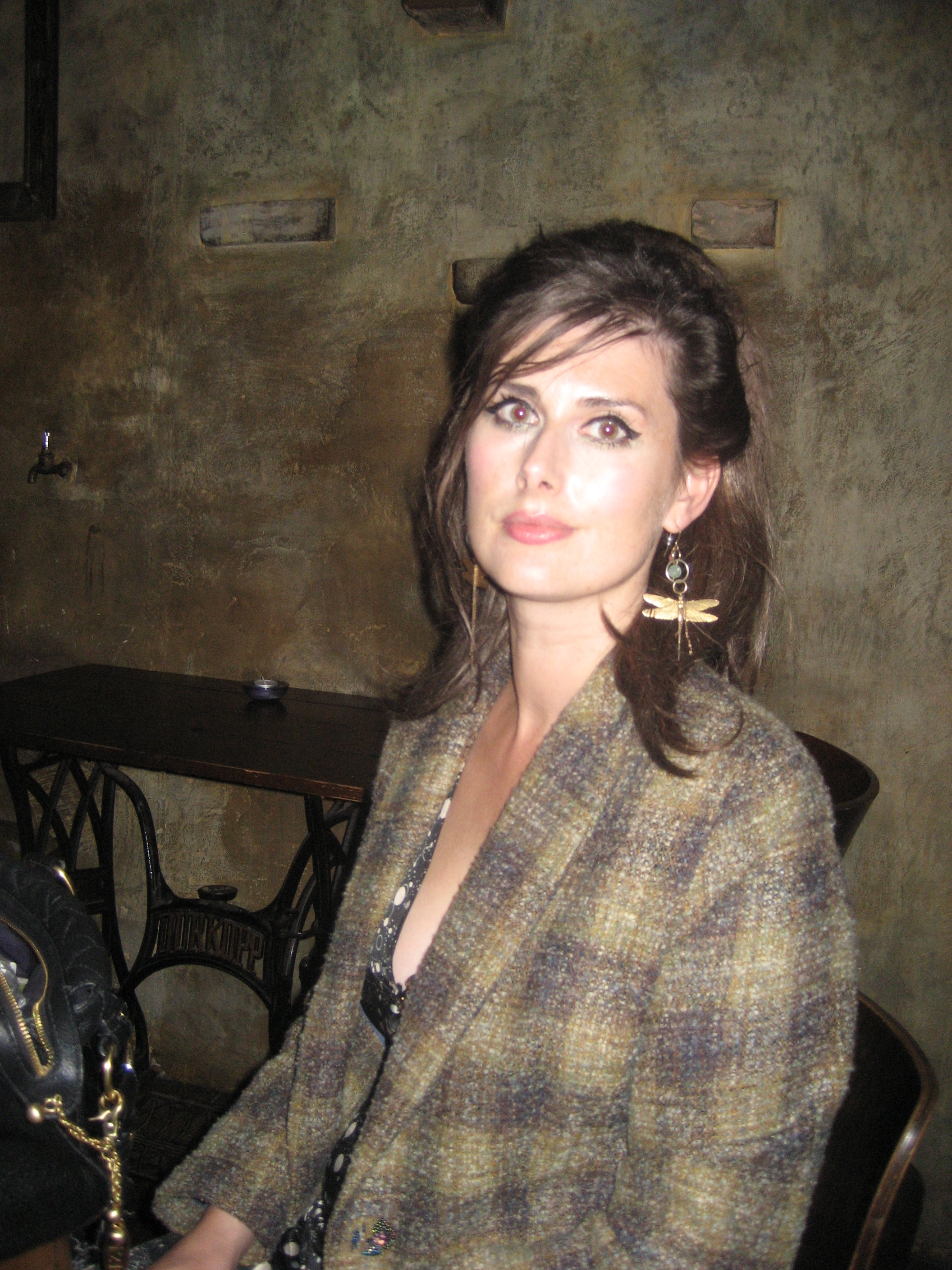
Me in another Kazimierz bar furnished with Singer sewing machine tables, Kraków, 2007

Kazimierz is now a vibrant art and cafe culture district and it was whilst in one of the many beautiful bars, which include bars like ‘Singer’ furnished with Singer sewing machine tables, that I found inspiration for the drawing.  I often contemplate the hellish fear that must overtake people when they are awaiting the onslaught of an enemy army. Documentaries are an audio visual record of this, but sitting in a room, that was originally a ghetto room where probably too many inhabited too few square feet, was sobering even with several Żubrówka‘s sunk accompanied by Polish cigarettes.

Kraków bar, 2007

Kraków bar, 2007

The room seemed to have been left just as if its inhabitants had walked out the door to find food, although perhaps they weren’t searching for food, perhaps they had fled from what must almost feel like the invasion of an alien army of super-humans from another planet as their wrath seems beyond that of civilised members of our own species.

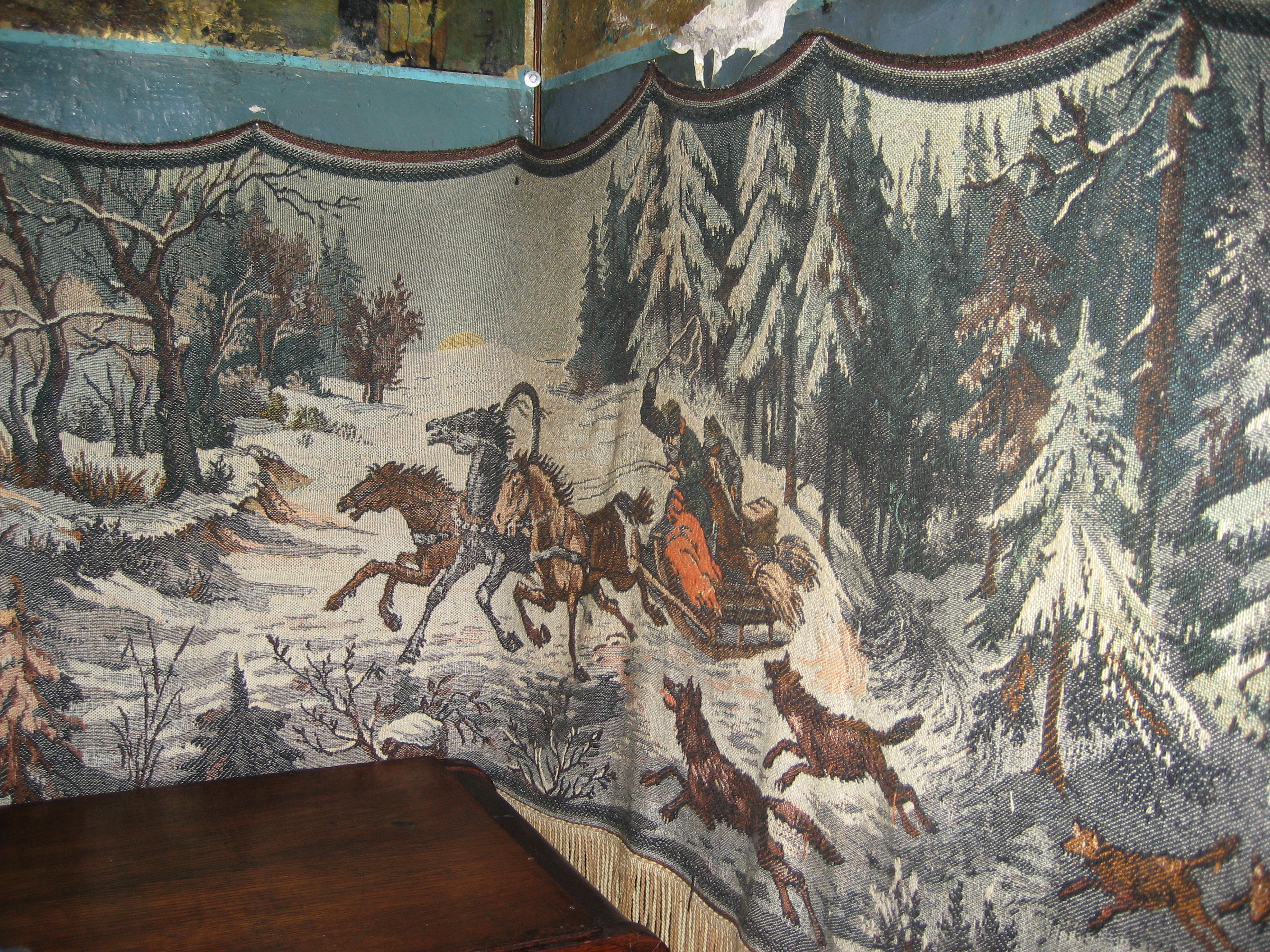
Tapestry in Kraków bar, 2007

Vintage Russian Tapestry in Kraków bar, 2007

The bar owners had decorated the bar with a kitsch vintage tapestry of wolves hunting a man driving a troika.  I wondered where the tapestry had come from, I imagined it as the type of possession left by fleeing civilians not just across Poland but Europe – a cottage perhaps where the inhabitants left their favourite tapestry and their children’s toys for the hellfire of the oncoming German army or from fear of retaliation from the Allied Armies.

Official USSR photograph of Red Army in combat WWII, Artist's own collection.

The end of the Battle of Stalingrad turns the tide of war and the Red Army begin their offensive and fight their way to Berlin, often taking revenge for the inconceivable brutality perpetrated by the Wehrmacht on Russian civilians.  Official USSR photograph of Russian soldiers in combat, WWII, 1944, Artist’s own collection.

In the drawing the dishevelled, handless Sindy doll represents the brutality often waged upon civilian populations during war as well as the memories of children at play before fate’s hand led them to their destiny.  The tapestry symbolises life preceding war, of a beautiful forest and traditions and landscapes lost forever to war.  And like the father and daughter in ‘Turin Horse’, many families met their uncertain fates together.

'Sindy and the Troika', black Biro drawing , 2008, by Jane Lee McCracken symbolises possessions left behind when people flee their homes during war or disaster.

‘Sindy and the Troika’, black Biro drawing , 2008, by Jane Lee McCracken symbolises possessions left behind when people flee their homes during war or disaster.

For further information and Luxury Archival Prints made to order by one of the best printmaker’s in the UK Jack Lowe Studio please visit my website.

‘Lily and the Kids’ – In the Deep, Dark Forests of Europe

'Lily and the Kids', 2012, Biro drawing and vintage German postcard, by Jane Lee McCracken (postcard Artist's own collection bought on Ebay)

‘Lily and the Kids’, by Jane Lee McCracken, 2012, quilt square design, blue and black Biro drawing and vintage German postcard of Der Wolf und die sieben Geißlein

Once upon a time there lived a Woodcutter in a cottage, deep in the forests of Europe, who collected images and objects.  No one ever saw the Woodcutter for he was a recluse and preferred the company of the forest animals rather than people.  But he saw everything, the good and the bad.  At first life and death as Nature intended and in time, life and death in Man’s own way.  The Woodcutter’s only companion was a television set where he gained his knowledge of the world outside the forests through film.  The forest animals came and went over time, the people and the wars.  And in response to all he saw in the forests and on the screen he made art – drawings and objects to remember the animals and people by and to ask ‘WHY?'”

‘Lily and the Kids’ is the first of a quintet of quilt squares specifically designed for ‘The Woodcutter’s Quilt’ which was part of the installation for ‘The Woodcutter’s Cottage’ Exhibition.  The quintet was created using black, blue and colour Biro drawings, vintage postcards bought on Ebay from my own collection and stills from Russian animation films.

'The Woodcutter's Quilt', 2012, transfers on calico, hand embroidery and black silk by Jane Lee McCracken

‘The Woodcutter’s Quilt’, 2012, transfers on calico, hand embroidery and black silk by Jane Lee McCracken

The other four squares include:

‘Bear’

'Bear', 2012, colour Biro drawing and vintage German Postcard by Jane Lee McCracken (Postcard Artist's own collection bought on Ebay)

‘Bear’, by Jane Lee McCracken, 2012, quilt square design, colour Biro drawing and vintage German postcard of Snow White

‘Ice Fox’

'Ice Fox', 2012, colour Biro drawing and digital montage of Ivan Bilibin postcard by Jane Lee McCracken

‘Ice Fox’, by Jane Lee McCracken, 2012, quilt square design, colour Biro drawing and Ivan Bilibin postcard

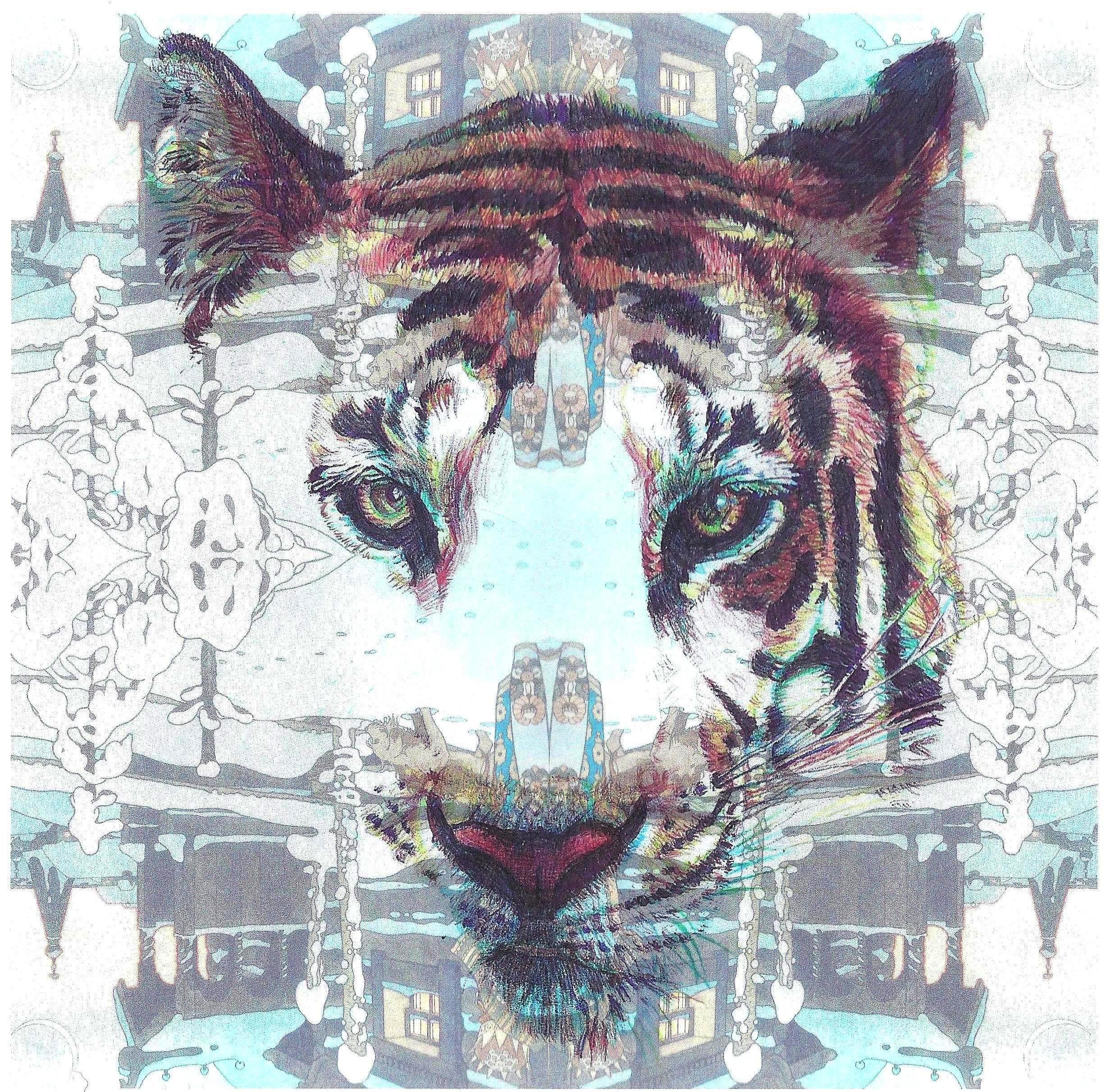
‘Siberian Tiger’

'Siberian Tiger', 2012, colour Biro drawing and digital montage of Ivan Bilibin postcard by Jane Lee McCracken

‘Siberian Tiger’, Jane Lee McCracken, 2012, quilt square design, colour Biro drawing and Ivan Bilibin postcard

‘Doll, Pink Boris and the Rabbit’

'Doll, Pink Boris and The Rabbit', 2012 colour Biro drawing and montage of Artist's still of the animation 'Fox and Rabbit' by Yuri Norstein, by Jane Lee McCracken

‘Doll, Pink Boris and The Rabbit’, Jane Lee McCracken, 2012, quilt square design, colour Biro drawing and Artist’s still of the animation ‘Fox and Rabbit’ by Yuri Norstein, 1973

‘Lily and the Kids’ and ‘Bear’ limited edition Archival Pigment Prints made by the excellent Jack Lowe Studio are sold with profits donated to the Wolves and Humans Foundation

‘Ice Fox’ and ‘Siberian Tiger’ limited edition Archival Pigment Prints also made by Jack Lowe Studio are sold with profits donated to the Born Free Foundation

For further information on prints please visit my website 

HAPPY BURNS DAY!

And to the Haggis,

“Fair fa’ your honest, soncie face,

Great Chieftain o’ the puddin race”

What the Children Saw – ‘LORE’ and Generation War Child

'The Sideboard II', 2009, red Biro drawing by Jane Lee McCrackenThis triptych portrays memories of a small child at play in a sideboard, within the safety of ‘home’, before the onset of war. It was inspired by the girl in the red coat from the film ‘Schindler’s List’, 1993, Steven Spielberg, as she wanders through the Kraków Ghetto while it is being ‘cleared’’. The Artist uses her niece to model for this piece to highlight the indiscriminate nature of war and how it can affect ‘anyone’ and to provoke understanding of loss by seeing victims as individuals and not statistics.

‘The Sideboard II’, 2009, red Biro drawing by Jane Lee McCracken part of a “triptych (which) portrays memories of a small child at play using a sideboard, within the safety of ‘home’, before the onset of war… inspired by ‘the girl in the red coat’ from the film ‘Schindler’s List’, 1993, Steven Spielberg, as she wanders through the Kraków Ghetto while it is being ‘cleared’. This piece highlights the indiscriminate nature of war and how it can affect ‘anyone’ and provokes understanding of loss by seeing victims as individuals and not statistics.”

No child should see what generations of children growing up during war have seen or are seeing.  Their eyes are forced to soak up the bloody spillage engendered by the very generations who are supposed to guide them safely to adulthood.  ‘Collective guilt’ particularly after WWII often dictates a rule of silence leaving many children and young adults unable to express the horror they have witnessed.  Dealing inwardly with a recurring nightmare spawned from observing the grotesquery of war, can cause psychological catastrophe for many and a lifetime of suffering.

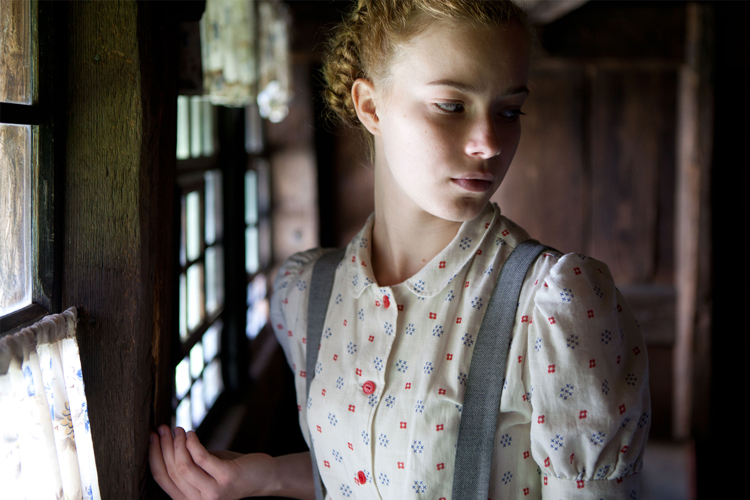
Saskia 'Lore', 2012

‘Lore’, Cate Shortland, 2012

‘Lore’, Cate Shortland’s 2012 film presents us not only with all of the above but ultimately shares a reality that has echoed down the years, ‘Only the dead have seen the end of war’, Plato

Lore and her siblings, 'Lore', Cate Shortland, 2012

‘Lore’, Cate Shortland, 2012

Through a fluttering curtained window into the cinematically exquisite trampled fairy tale of a fleeing Nazi family, teenage Lore turns her beautiful face towards the camera and commences the unravelling of her contorted mind of lies.  The chorally haunted forests of Schwarzwald provide the setting for an epic journey’s beginning, as Lore’s high ranking Nazi parents disappear into the forests deep in the American enclave, leaving their five children to find a way through the aftermath of WWII to Grandmother’s in Hamburg.  The extraorindary Saskia Rosendahl’s ‘Lore’ is forced to confront her Nazi indoctrination, anti-Semitism and hero-worshipping of her father whom she discovers to be a war criminal responsible for genocide; she witnesses the scaling denial of a nation, all whilst leading her young brothers, including baby Peter and her younger sister Liesel to safety.

'Lore',

Saskia Rosendahl’s ‘Lore’, Cate Shortland, 2012

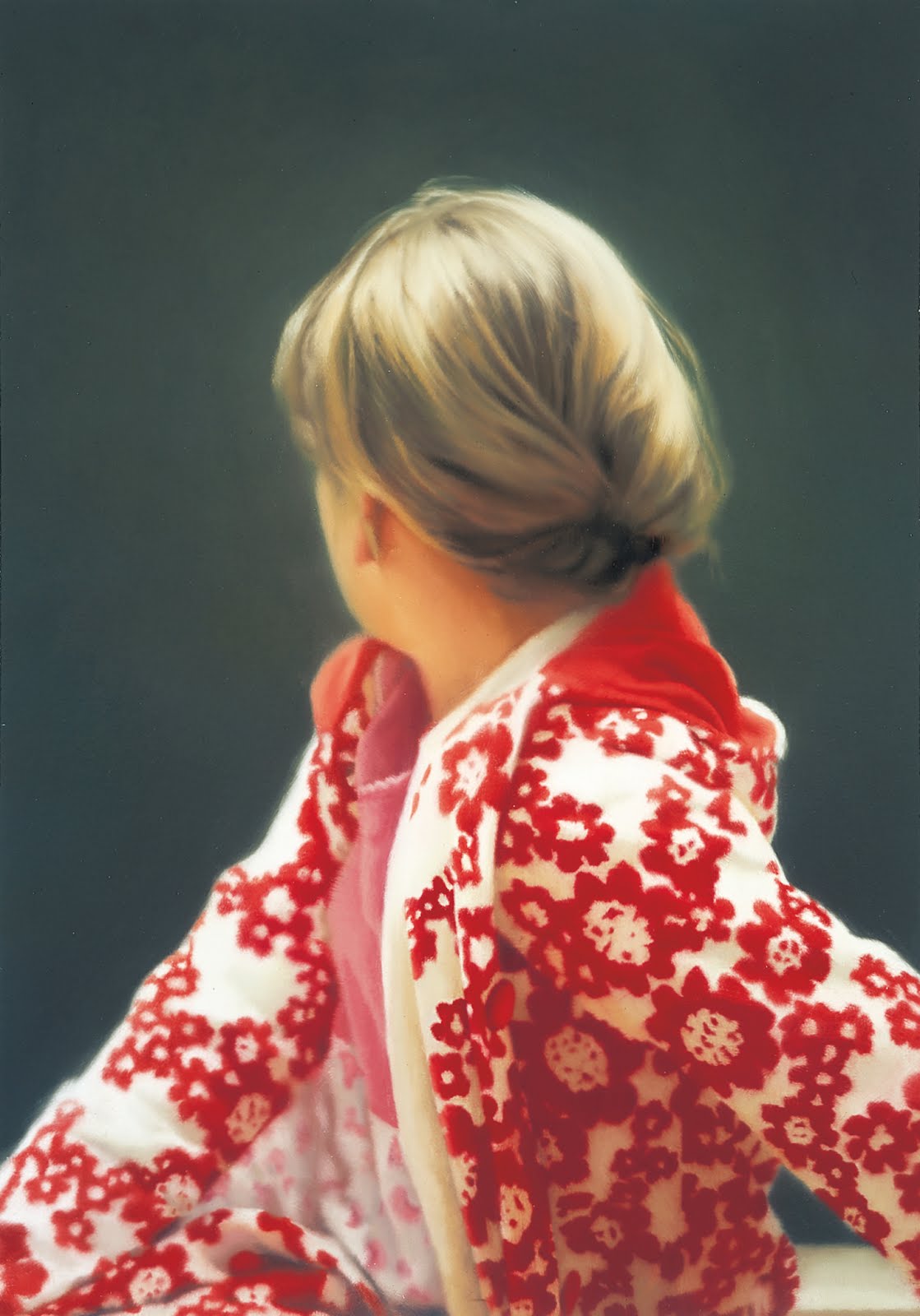
Adam Arkapaw’s stunning cinematography often gentle and sun-blanched, has wisps of Gerhard Richter’s paintings flickering through it.  A motion parallel to Richter’s ‘Betty’, 1988 (Richter was himself a child during WWII) and homage to his blurred photo-paintings echo throughout the film especially in the sequence when Lore dances with her sister Liesel.

'Betty', 1988, Gerhard Richter

‘Betty’, Gerhard Richter, 1988

Many refugees experienced chance, often fleeting encounters with strangers who changed the course of their lives in the unwinding chaos of WWII Europe.  A Jewish concentration camp survivor, Kai Malina’s ‘Thomas’, covets Lore and eventually becomes the siblings guardian angel whilst Lore’s beliefs and body crumble in the rubble and decay of ‘Gomorrah’. The greatest achievement of this impressive film, for there are many, is to communicate a picture of what discovering the unfolding horror show of war looks like, as if we too are there sharing the unearthing with the children.  This film gifts us within a closer proximity than others of its ilk, of trying to comprehend the aftershock of WWII.

Lore and her siblings, 'Lore', 2012

Lore and her siblings, ‘Lore’, 2012

It is often impossible to put into words something you have never seen or experienced yourself, but “A picture shows me at a glance what it takes dozens of pages of a book to expound”, Ivan Turgenev. Perhaps images more than words help us ‘the unexperienced fortunates’ gain any sort of understanding of what witnessing the horror of war actually means.

Detail of Julien Bryan's "Ten-year-old Polish girl Kazimiera Mika mourning the death of her sister, caused by strafing German aircraft, near Warsaw, Poland. 13 Sep 1939"

Detail of Julien Bryan’s “Ten-year-old Polish girl Kazimiera Mika mourning the death of her sister, caused by strafing German aircraft, near Warsaw, Poland. 13 Sep 1939”

For further information about ‘The Sideboard’ triptych, please visit my website

Death’s-head Hawkmoth (Acherontia atropos) – Biro Drawing Moth Series

'Death's-head Hawkmoth', 2012, colour Biro drawing by Jane Lee McCracken

‘Death’s-head Hawkmoth’, 2012, colour Biro drawing by Jane Lee McCracken

‘Death’s-head Hawkmoth’, is the first of a quartet of colour Biro drawings of British Moth species celebrating the beauty of moths.  The drawings were created as integral elements in the pattern design for the ‘British Moth Throw’, made in 2012.

'British Moth Entomology Drawer', 2013 by Jane Lee McCracken, the Mercer Gallery Harrogate.  Dressing table is Artist's Grandmother's, circa 1940

‘British Moth Entomology Drawer’, 2013 by Jane Lee McCracken, the Mercer Gallery Harrogate. Dressing table is Artist’s Grandmother’s, circa 1940

The ‘British Moth Throw’ illustrates the beauty of moths and attempts to dispel their image as dusty, cloth eaters whilst highlighting the rapid and devastating depletion of many British Moth species.

'The British Moth Throw', 2012, detail, hand-cut transfers on calico

‘British Moth Throw’, 2012, detail, hand-cut transfers on calico

'The British Moth Throw', 2012, detail, hand-cut transfers on calico

‘British Moth Throw’, 2012, detail, hand-cut transfers on calico

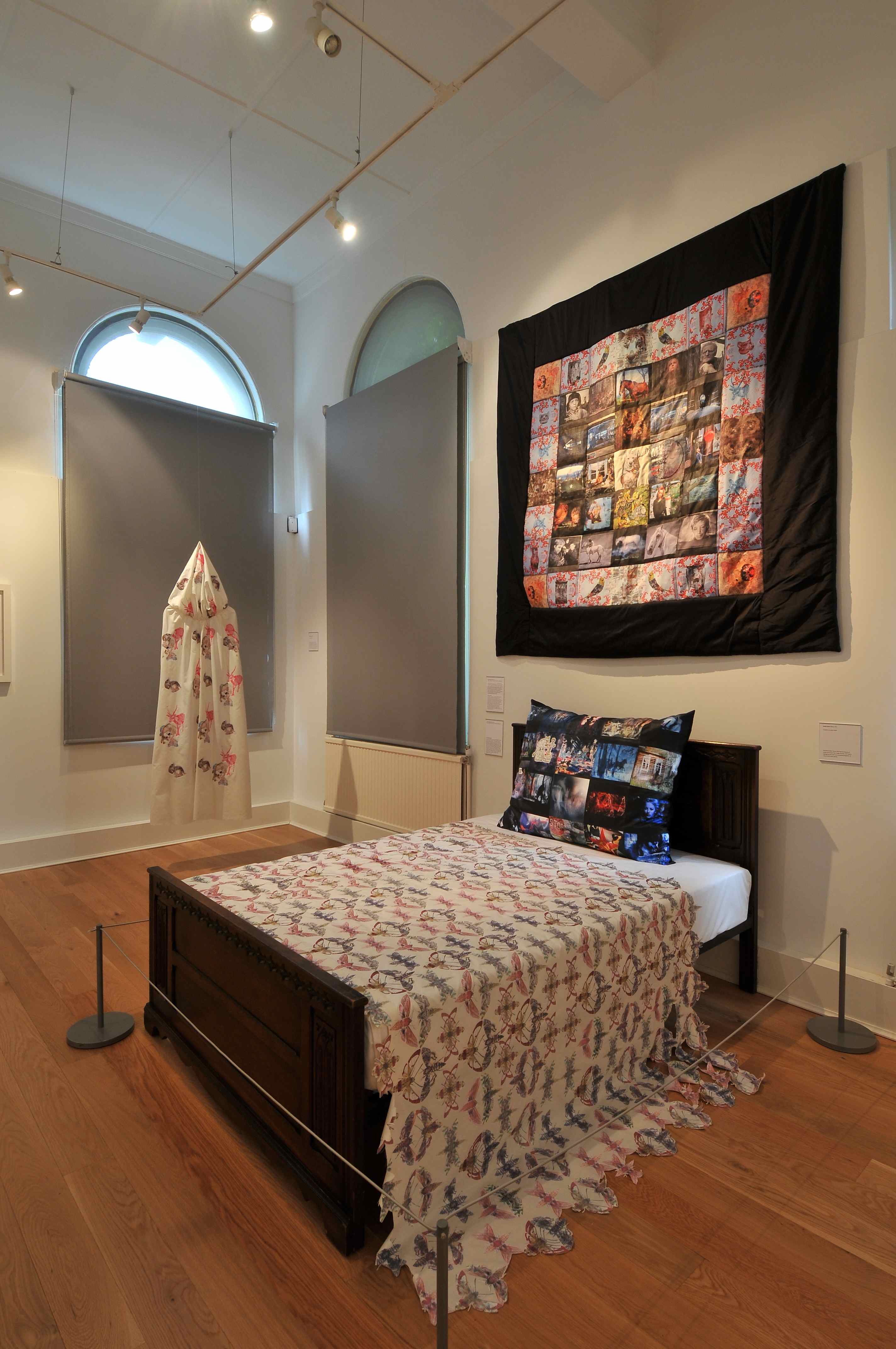
Made from printed transfers, hand-cut and applied to calico the throw is displayed on the Artist’s Grandmother’s Jacobean bed, circa 1940.

'British Moth Throw' displayed in 2013 at the Mercer Art Gallery, Harrogate - Artist's Grandmother's bed circa 1940

‘British Moth Throw’ displayed in 2013 at the Mercer Art Gallery, Harrogate – Artist’s Grandmother’s bed circa 1940

Prints of the British Moths series are available from my website shop and are sold in aid of UK charity ‘Butterfly Conservation’

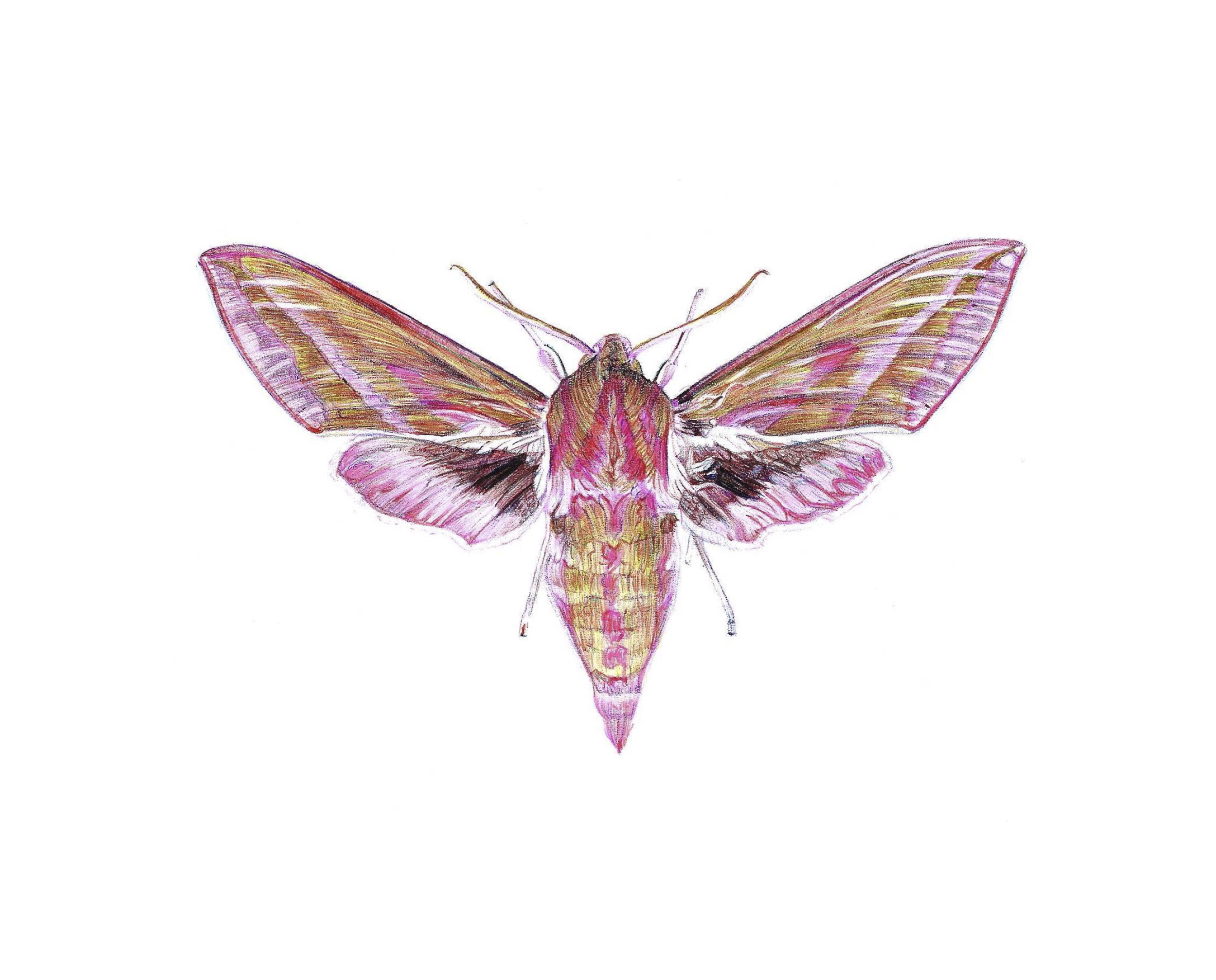
'Small Elephant Hawk-moth', 2012, colour Biro drawing by Jane Lee McCracken

‘Small Elephant Hawk-moth’, 2012, colour Biro drawing by Jane Lee McCracken